Monday, February 18, 2013

MALLORCA: February Calms


In the middle of a blue sea it appears almost magically, this sparkling jewel. As seen from the air, the imposingly rugged Serra de Tramuntana mountains would seem to present a formidable barrier to the Iberian mainland to the north.  However, circling at 10,000 feet you notice how vulnerable this saddle-shaped island is on its western and eastern shores.  Here there have been prehistoric settlements, the Romans and the Byzantines, the Moors and Berbers, the Counts of Catalonia and the Kings of Aragon, all of which had influence and claim to this land.  Now I've arrived at the largest island in Spain's autonomous Balearic Island archipelago, anxious to taste and explore.
Along the Ma-13A Wine Road


It is the food and of course, the wine which are my beacon in mid-winter Catalonia. This islands beautifully rugged landscape is dotted with lamb, filled with aromas of roast suckling pig (lechona asada), and stewed in the mild flavors of turbot. Mallorca produces most of its wines within its two D.O. regions (Denominacion de Origen) of Consell-Binissalem, a corridor running from Santa Maria del Cami to industrial Inca along the Ma-13a wine road, and in the east of the island among the remote rural villages of the Pla i Llevant DO. Lower tiered wine production falls under the 'Mallorca Regional Wine' designation, most of which is produced in the western foothills of the Serra de Tramuntana's and Costa Nord region. What is produced here tends to be enjoyed here.

This crumbling limestone landscape in February is a sea of white almond tree blossoms, grey-green olive groves sprinkled with orange trees and scored with rock walls and terraces.  In its abundant sunlight we enjoyed the freshest sea foods, rich traditional dishes and bowls of the most delicious olives while in awe of the landscape/seascape that graced our views.  One day it was a glorious picnic lunch at the islands exposed northern tip of Cap de Formentor, followed on another by a pilgrimage to blustery Valldemossa(the island's highest village), where composer Chopin spent a notable monastic winter in 1838. Our quest was rewarded here with savory dishes of rabbit stew and roast lamb, paired with full bodied wines of the local Manto Negro grape.

Hanging on to the edge of the terraced north face along the Tramuntana's, we drove to Soller passing the most picturesque coastal hill towns.  Another sunny day, and we were dining on charcuterie at a prominent olive producers in Caimari, deliciously contrasted with a bright Premsal Blanc and Chardonnay blend from a local quality producer. With another brilliant sunrise, we were driving southeast towards Manacor, visiting ancient hilltop towns of Arta and Petra, both villages of the Pla i Llevant DO, and then on to enjoy the days fresh catch in sparkling Portocristo.

Another Alcudia sunrise and it's a quick drive across the island, recharged by an upbeat day in cosmopolitan Palma.  After a morning exploring the Palace(Palau) and the Cathedral(Le Seu), we dined across from the harbor at the superb Caballito Del Mar on Black Pallea and Turbot of two textures.  We chose a beautiful Verdejo from the mainland's Rueda DO to complement our dishes and make us thirsty for more.  But, that is how it is in Mallorca.  A little is never enough, so you want more.  Back on the east coast in picturesque Port d'Alcudia with its sprawling resorts and long white beach, I asked a local if our good fortune with winter weather is typical.  He replied, "in Mallorca we say, 'February calms'."

And so it was.  Our off-season visit to sunny Mallorca calmed our spirit as we walked along its beaches, wading in the cool Mediterranean. It slowed our pace, but not our absorption rate as compared to our Barcelona visit the week before. At the end of our visit we agreed that our time in Mallorca was not long enough and made plans to return.  Not when the northern Europeans invade, but when the island calms as it has this time fur us in off-season Mallorca. 
'Exciting' petanque along Bay of Alcudia

Registration for my next certification exam for Wine Educator has been confirmed for the end of February.  Results will be shared here as soon as available, but until then, I'll be inquisitive about the wines of the world and I'll try to stay Mallorcan  'calm'.

Salute'!


Thursday, January 24, 2013

SPAIN: Pened'es in Quality Focus

Alt Pened'es Bodega St.Joannes vineyards
Winter in the Pened'es DO of southeastern Spain usually means air temperatures in the 40's and an average rainfall of about 2 inches each month.  The sun always seems to be around in this the largest vine region and greatest wine volume Denominación de Origen of autonomous Catalunya. Wide and open, it is sandwiched between the East-West fortifications that are the Pyrenees mountains and coastal Garraf Massif wherin lies this Catalan Central Depression with its tiers of plateaus, coolly influenced by the great sea to the South.
La Morella, height of the Garraf Massif


These lands are an ancient crossroads, having survived with more than 2000 agrarian years of wine production in a swath of island hamlets and then a galvanizing 17th century farming boom. These people of the land,  these hard working Catalans persevered;  persisted following centuries of invasions and foreign occupations, only to be followed by decades of isolation, an outlawed culture/language, vineyard decline and even a tragic civil war. Yet, the proud Catalan culture remains alive and vibrant.

Climatically Mediterranean, Penedès, with its wide range of micro-climates, is divided into three elevated tiers or sub-zones filled with mixed soils of limestone, sand and clay:
  • Baix Penedès (Bajo)takes in the low-lying coastal areas. Unsurprisingly, this is the warmest part of Penedès and specializes in the production of full-bodied red wines from Garnacha, Cariñena and Monastrell grapes. The main village is the historic Vilafranca del Penedès. 
  • Medio Penedès forms the middle plain section of this DO and has the highest level of production. Vineyards are located at elevations of 825 to 1649ft (250–500m) and provide the majority of the region's Cava grapes (MacabeoParellada and Xarel-lo) as well as Ull de Llebre (Tempranillo), and introduced international favorites like Cabernet Sauvignon and Merlot.
Across the Lower & Middle Pened'es, other international varieties such as Riesling and Sauvignon Blanc share acreage today with traditional white varieties of Malvasia de Sitges, and Moscatell d'Alexandria, producing a wide style of delicious, uniquely Spanish still table wines.
  • Alt Penedès is also known as Penedès Superior. Its vineyards are as high as few in Europe, having altitudes of 1640 to 2625ft (500–800m), also enjoy the region's highest rainfall. Some of Spain's most remarkable white wines are produced here from cool-climate grape varieties such as Chardonnay, Riesling, Gewurtztraminer and the local Parellada.
 Central Depression in Catalan Yellow
Attempting to standardize the regions production and quality, the Regulating Council of the Denominació d'Origen was founded here in Catalunya in1960. Currently, the Regulating Council has about five thousand wine producers in its ranks, with about two hundred and seventy cellars(bodegas) which are aligned with almost 140 companies dedicated to aging and exporting an annual wine production of nearly 70 million liters from more than 26000 hectares of vineyards.  That's a lot of juice!.

Being close to cosmopolitan Barcelona, the region is also the epi-center of Spain's modern day wine revolution. Vilafranca del Pened'es is at the center of  still wine production, and is also the home of regions largest producer and perhaps its greatest innovator, Jaime Torres. Introducing then new ideas such as stainless steel fermentation and temperature controlled tanks, Bodegas Torres was the first in Spain to experiment with international varieties in the 1870's.  Today, it is the largest winery in Spain. A century later, innovative Bodegas Jean Leon (Ceferino Carrión) introduced single cuvee or single vineyard (pago) bottlings in the 1960's, and advanced international marketing strategies for the regions improving still wines.

Pened'es is today synonymous with Cava, a traditional method sparkling wine, having its origins from José Raventos of Codorníu in the early 1870's following the bodegas vineyard replanting to native varietals after the widespread devastation of phylloxera. The nearby small town of Sant Sadurní d'Anoia is said to be the birthplace of cava, where almost 90% of Spain's sparkling wine is produced today. Uniquely, it is the product of a blend of indigenous grapes: an acidic flagship, Xarel.lo, widely planted and fruity Macabeo(Macabeu) and the native Parellada, that give this sparkler its special character. Increasingly, Chardonnay is making its way into this traditional blend.

Cava regulations were established by the Ministy of Agruculture in 1972 with the El Cava Regulations Board, and then adopting a delimited 'Cava Region' in 1986 to comply with EU standards. A further refinement of regulated practices was established in 1991 with a singular Cava DO. The regions Cava Regulatory Board recently announced that cava for export had increased by 50% in volume over a ten year period from 2001. Catalonya's sparkling wine production would then seem to be in effervescently good shape.  However, things are not all bubbles in cava town.  Merce' Rossell, Chairperson of PIMECAVA, sets a higher bar, saying recently, "we have to sell cava as an exclusive, glamorous product", indicating the importance of a 'quality' prestige, as with Champagne.

Beyond product marketing, there is currently also a Pened'es classification overhall in the works after 50 years of developing regulations.  In an October 2011 issue of Decanteur, it was reported that the newly elected president of the Regulatory Council of the Penedès DO was leading a campaign to further demarcate the region into sub-zones that would help promote superior sub-regions.  Josep Albet, owner of the Albet I Noya winery says that the existing appellation was outdated and not reflective of the great diversity of terroirs within the DO.  The current process of determining the new sub-zone boundaries is challenging enough, and then still requires approval from the Penedès Wine Council.


With a renewed focus on the region, Robert Parker's July 2011 The Wine Advocate rated 18 distinctive wines of the Pened'es from 8 different producers as exceptional or outstanding. As the region continues adopting quality over quantity, the Pened'es of late has been selling fewer bottles abroad than the volumes seen in its high water mark from 2007-8 as announced by the Spanish Wine Market Observatory. But, according to the prestigious Catalan Institute of Wines and Vineyards, these are today wines representing the best of the region; world class wines of improved and improving qualities. For the rest of us, our focus on searching out the fine wines from the Pened'es continues to be a rewarded quest of value and quality.

And then, there's Barcelona, that cosmopolitan, thriving Catalan metropolis, where annually a quarter of the worlds cava is consumed!  As seen here, perhaps there are unique qualities in just living to consume life!


Salutacions e Bona Salut!

This entry Posted from Barcelona, Spain

Sunday, December 30, 2012

BRAMBLES; Tis' the Season

Winter Vineyard in the Loire
Short days, long nights and the wet chill of Winter now blankets the vineyards of the northern hemisphere.  Bundle up and you can offer yourself a few layers of comfort against these elements so that vineyard workers can maintain and cellar rats can dance with hoses and barrels.  It is the time to access the most recent harvest and to place it into a historical perspective, as has been done for millennium. Too, it is the time to look forward to the brighter, warmer days of the Spring.  With a renewed perspective(isn't that what a New Year is about?), I will again attempt one of the final chapters of my Wine Educator certification mid-February, with the eternal hope that this will be the time I get over the hump.  Honestly, it takes a while for many of us to get over the disappointment of not being able to achieve our important personal goals after we've invested so much time and money into them. A new season or a turn to a new calendar page can then give us the perspective we need.

"And I can see that something else died there in the bloody mud, and was buried in the blizzard. A peoples dream died there. It was a beautiful dream..." (Black Elk)
Pain and tragedy are an unfortunate part of part of life. But, so too is change. Life, I think is also the increasing loss of innocence.  Perhaps then in this Season of the Winter Solstice, we come to celebrate the joy of innocence before it changes and we become calloused adults hardened by the world's realities. So in speaking of things that give our hardened souls hope, a few news items recently caught my attention in this this Season of hope:

  • New research, reported recently in Wine Spectator, reaffirms that the origins of cultivating grapes for wine most likely began in southeastern Anatolia of modern day Turkey. Part of the 'Fertile Crescent'. this melting-pot region, along with Stone Age neighbors Georgia, Armenia and Azerbaijan, has long been considered the beginnings of western-style villages and civilization. Within the same region about two years ago, archeologist discovered a 6,000 year old Neolithic winery in an Armenian cave, with clay fermenting vats and even a rudimentary wine press!

Perhaps demonstrating how far we have evolved(or not), the nearby village of Sirince, Turkey, long known  for its apple and berry fruit wines, is where a local businessman, Erkan Onoglu, has created a 'Wine of the Apocalypse', or 'Vino dell'Apocalisse'. It was further reported that across the 'Crescent' in the vine growing Ukrainian Crimea, the New World winery has shored up with two weeks of provisions and has set-up 400 beds and five(5) suites in their winery caves to serve post-Apocalyptic consumers. Just in case...

  • Wines delivered direct to domestic consumers (DtC) continue to increase. Wine and Vines reports a 13% greater volume in wine sales compared to12 months ago, topping $224 million in revenue. Off premise sales grew as well, with a reported 6% increase in the last 52 weeks. Reasonably, I think, more American wine consumers have more purchase options than ever before to the economic benefit of the entire segmented industry.

  • New first-time consumers coming into the market constitute the growing segment of the 'millennials'  and the wine industry knows that they represent an engine of growth.  New York Times Business pages recently reported that new 'eco-friendly' containers, out-of-the-box packaging(some literally in a box), and emerging social media tools are increasingly new ways to attract these new buyers. "Beverage packaging is not purely functional, but a way of reaching your buyer"' said David Turner of Turner Duckworth, a prominent design agency. Matt Zimmer, chief executive of Stacked Wines, echoed "we see an industry trend to more convenient packaging". As a result, wines in packaged in eco-friendly boxes, pouches and even plastic bottles are securing more room on retail shelves and growing dollars for retailers. 

  • AP reported recently that Napa winegrowers cannot find enough nursery stock vines to replant their aging cabernet sauvignon vines.  Most of the vines were replanted in the early 90's following an outbreak of that vineyard malady,  phoxllera, that greatly impacted many of the nation's preeminent vineyards. Evolving environmental concerns, increasing sales volumes with steadily increasing bottle prices and the term life replanting of aged vineyards have created a perfect storm that continues to challenge these high end growers. It probably means that Napa Valley cabernet sauvignon is not going to get any cheaper or easier to find as consumer values.  But, it is farming after-all, and farming is cyclical.
Our lives, like that of the vine and the vineyard are a long cycle.  Throughout, there are the peaks and valleys of joy and despair, of inspiration and reward.  Looking forward to the Spring and its cyclical rebirth, we will again be inspired to achieve what is long held in our hearts.  Hopefully, with a glass of wine in our hands and a little Peace on Earth and Good Will Towards Men. Tis' the Season!


Cheers!

Thursday, November 29, 2012

BRAMBLES: A Vintage Year?


Harvest hues of cascading pistachio leaves dance outside as I investigate this years annual passage, our regional grape crush. Comparisons, I guess, are inevitable because it is generally easier for us to place things in common groups or broad categories. Locally, after successive years of challenging and smaller harvests following a bountiful 2007, the regions grape growing fortunes improved dramatically this year. With descriptors like 'exceptional', 'generous', and 'high quality', California's total premium grape tonnage appears to be well beyond 10% above last years according to the industries Wine Institute. Normal picking timelines were encouraged in 2012 by mild weather, sustained sunshine and inconsequential late season rainfall across all the diverse North Coast winegrowing appellations..

Overall, Sonoma County vintners and winegrowers reported a textbook perfect growing season. Winegrape revenues for the regions should exceed $100 million above last years total according to industry sources. “It has been a great harvest for Sonoma County growers and winemakers. Yields and fruit quality have been exceptional. The rebound in grape yields was badly needed for Sonoma County growers after two harvests with lower than average yields. The record tonnage harvested in Sonoma County was in 2005 with 231,000 tons and 2006 yielded 216,000 tons. I think the 2006 total could be exceeded this year, perhaps reaching 220,000 tons. As we celebrate the 2012 vintage, growers are already beginning to plan for 2013.”, according to President Nick Frey, of Sonoma County Winegrowers.

Some of the larger appellation highlights included:
  • Alexander Valley ( warm growing in the northeastern county) "We are finding tremendous flavors have developed in the fruit from the overall ideal weather this season. I think this will prove to be an outstanding vintage once the new wines are fully evaluated.” , reported  Jim Young, President/CEO, Robert Young Vineyards. Those evaluations were echoed by Brad Peterson of Rawah Vineyards, offering, “2012 has been a very good vintage. We finished our last block on Thursday, October 18. The fruit quality was excellent and yields in our vineyards were up 20-30%. The resulting wines are tasting excellent, as well.”.

  • Carneros (cool growing on the counties southern border) “It has been an ideal growing season with mild temperatures and opportune heat spikes to get the grapes to full maturity", said Steve Sangiacomo of the prestigious Sangiacomo Family Vineyards. "We have finished the harvest just in time (October 19) — before Mother Nature delivers the first storm of the season.  We feel very fortunate to get everything in, and most importantly, with the quality at such a high level.”
  • Dry Creek Valley (east of the Coastal Ranges)  "...Zinfandel and Cabernet crops were big,"...."we had done our thinning work, and nature gave us good weather and(we) achieved that win-win situation that makes both growers and wineries happy: a bountiful and high-quality crop made possible by careful work in the vineyard.” proclaimed Winemaker Tim Bell, of Dry Creek Vineyards.

  • Russian River Valley (cool, foggy mornings benefit chardonnay and pinot noir) Sparkling and still wines produced at J Vineyards & Winery enjoyed a push according to Vice President of Winemaking, Melissa Stackhouse.  "Overall, I’d have to say that 2012 may have surpassed 2007 as the ‘perfect vintage’.”
  • Sonoma Valley (diverse inland vineyards west of Napa Valley) " We haven’t seen such a tremendous harvest in terms of both volume and quantity in years!", said Kunde Family Estate winegrower, Marcia Kunde Mickelson.  "Our biggest issue has been tank space due to the bounty of this harvest, but we’re squeezing by!". 

With grape tonnage significantly above last year, Napa Valley may have just also produced a 'perfect' vintage, and some growers have even called 2012 the 'best vintage ever'. “Pick dates that are determined by ripeness are always preferable to pick dates determined by impending rain storms,” says Amy Warnock, viticulturast at Atlas Peak's Stagecoach Vineyards. Throughout wine country vineyards, when Mother Nature cooperates as she did this harvest, everyone benefits. Reflecting, John Wilkinson, a director of Napa Valley Grapegrowers, said, "the growers are not only getting offers for their fruit that they might not have been getting in 2008 and 2009, but getting good prices."


Further east in warm growing Lake County AVA the estimates for value of its winegrape crop are expected to be at a solid $35-40 million, considerably ahead of last year. However, not all varieties will seem to benefit. "The dry weather up to now has been welcome (in contrast to the last 2 years), except that (cabernet) fruit may be losing weight in the dry heat, if we can’t harvest it soon,” cautioned Randy Krag, a Vineyard Operations Manager in the Red Hills appellation...."and the quality is excellent this year". And, yet another dose of reality was offered from the cooler and diverse Mendocino County appellation. Here, expectations were for a near picture perfect harvest this year, avoiding the natures challenges of the recent past.  Yields were anticipated to be up as much as 10,000 tons above last year.  However, something other than Mother Nature can effect a stellar harvest. "There were definitely examples where the pick was cancelled because there wasn't enough people to put a pick together,” said Zach Robinson of Hursch Vineyards.

So this North Coast grape harvest of 2012 was of great volume and presumably very good quality.  It had the best of weather, and finds a marketplace that needed a bumper crop.  Not all growing regions were treated equally, but just about everyone had few negatives to offer.  So, it may turn out to be one hell of a vintage season for wine lovers.  But, generally, even in a 'vintage year', premium grape growing is still farming; challenged by all that farming offers. Although, grapegrowing can be very delicious farming.

Salute'

Links:
  • http://www.wineinstitute.org/
  • http://www.alexandervalley.org/
  • http://www.wdcv.com/dry-creek-valley/
  • http://www.rrvw.org/
  • http://www.sonomavalleywine.com/
  • http://www.lakecountywinegrape.org/
  • http://www.napagrowers.org/

Monday, October 29, 2012

MALLORCA: Seperate & Increasingly Sunny

Binissalem vineyards
 When looking at the view count from the over 50 installments of this post, those that seem to draw the most interest focus on a geographical region.  But now, as I've passed the theoretical portion in my pursuit of the Wine Educators certification, the details of worldly viticulture and oenology have given way to the practical: dissecting wine in a glass. It has been five(5) weeks since the last Wine Faults & Imbalances exam, and as yet the Society has not released my scores.  So I keep drinking the wines of the world, I try to keep up on wine news and find new opportunities to teach about the wonder of wine.  But within myself  I continue to find a steady undercurrent of streaming interest in wine places, most recently sunny Mallorca of Spain's Baleric Islands.

Although there is evidence of Stone Age fermentation vessels here on these isolated islands,  it is generally observed that the Romans brought wine to Mallorca prior to 100BC. Centuries later the Moors were here, then the Catalans, and then for almost five hunded years following, the wines of this island were celebrated with some of the best in Europe. Near the end of the 19th centuiry, this island barely 40 miles wide, had more grape vine acerage.than larger Sonoma County has today.  Mallorca was not immune when phylloxera raged across its agricultural and rugged landscape.  Even as the vineyard blight was not enough to bury the islands wine industry,  almost a century of political unrest, World and Civil Wars followed. With the expanse of middle class consumerism in post-WWII, eventually the sunny islands economies began a progressive move from agriculture to tourism. Today tens of millions of international visitors each year drink most of Mallorca's wine production on holiday and have seen a contemporary push towards new investments, technological improvements and increased quality in the islands long established wine industry.

Wines of the sun drenched Balearics have come a long way.  In the late 60's, the esteemed Andre Simon in Wines of the World said, (their wines) "never go higher than the simple vinos corrientes that are usually good...", and found the region so unworthy as to  not include the islands on his wine map of Spain. But, along the way, 1970's national legislation to align with its ECC trading partners upgraded the industry standards, regulating quality, production and varietal selections. Reflecting Spanish quality controls, its mufti-tiered system was topped by DO or Designation of Origin wines of superior quality and became law in 1990. But in Mallorca, like the majority of Spain, most of the production was in regional wines, generously grown in higher volumes across calcareous to fertile terrains.
Mallorca, largest of the Balerics

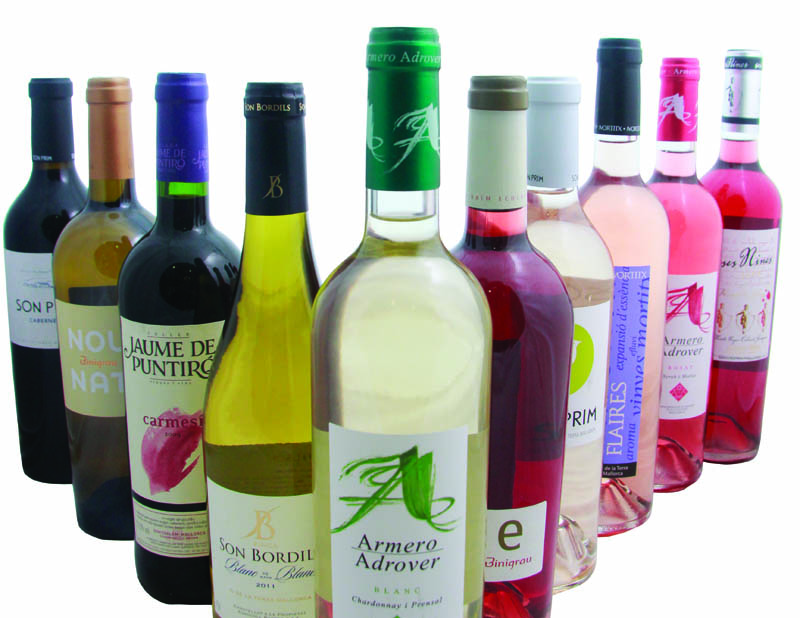
South of the impressive Serra Tramuntana, lies Binissalem DO, an expanse in the high central plain of about 1000 limestone and sedimentary soiled acres that parallels the cross island Ma-13a motorway. It is the first of the Baleric Islands DO's, and was established in 1991. Here quality wine lovers can now find growing a selection of Catalan whites, like Macabeo(Viura) and Parellada, international varieties of Chardonnay and Moscatelle.  The majority of the plantings, however, are the indigenous high-acid Moll(Prensal Blanc), its citrus/ floral, high acid a base for still and popular sparkling whites. Noting its expressive nose with ripe fruit, the respected English Decanter(906/09) recommended: Jaume de Puntiró, Daurat, Binissalem 2006 (Prensal Blanc) in its review of surprising Spanish white wines.

Across about 600 hectares, this largest of the DO's today supports more than a dozen prominent wineries, some with viticultural histories going back hundreds of years. Red varieties dominate grape plantings in Binissalem with the usual suspects of Tempranillo and Granache, plus Cabernet Sauvignon and Monastrell. As with white varieties, indigenous reds are more numerous with the full-bodied blackberry & fig notes of  Mantro Negro, dominating(about 40%) plantings in the DO, and the red fruit Callet, base for many of the region's rose's.


In the islands oldest wine growing region sits a collection of eighteen(18) villages that make up one of Spain's youngest Designation of Origins. With some of the current estates having a history going back to the end of the 19th century, it was this region that gave birth to Mallorcan wine more than two millennium ago. On the northeast side of the island eleven wineries and 64 growers on more than 200 hectares make up the region of  Pla i Llevant DO.  Here too grow international whites Chardonnay, Moscatelle and even some Riesling with the well-adapted native Prensal Blanc. Low alcohol Mediterranean reds of Pinot Noir, Monastrell, Merlot and Cabernet Sauvignon are here too, often to blend with native Montro Negro and Callet varieties.


Today, this isolated islands deeply rooted ancestral peasant culture is serving well the passion of the dedicated families of the regions small producers as they dedicated themselves to making better wines with each harvest. Increasing international awards and glowing reviews from global wine writers are beginning to put tiny Mallorca on the wine map.  Combined with excellent, critically acclaimed 2009 and 2010 vintages, Mallorca's centuries of isolation may soon be something of the storied, but sunny past. Yet, I remain anxious to prepare for the next phase of the Wine Educator's exam, so today I called the Society today to speak with the Director of Education. He advised that I missed passing by correctly identifying two(2) faults. As disappointed as I am, this chronicle will then continue and I'll try getting over this difficult(for me) section of the exam on the next scheduled date.

Alcu'dia
Until then, Salud!