Showing posts with label Monastrell. Show all posts

Tuesday, February 28, 2017

BRAMBLES: Climate Changes, Values Found


Under a bright sun the thermostat displayed around 70 degrees that cloudless afternoon.  To take advantage, I gathered lunch for the deck, a lean seared steak salad with kale, peppers, and tomato, and presented it to a personable glass of 2009 Ribera del Duoro from a reliable Old World producer.  As the ruby jewel shimmered in the sunlight, I thought things were just about perfect at that satisfying moment.  It was the end of January, and I was not in the Southern Hemisphere, but in the North Bay's wine country!  In the days that followed temperatures again dropped and the skies clouded. And then it poured; contributing to one of the wettest January's here in recent recordings.

That wet pattern continued thru February, taking the region fully into the season of power outages, flooded roads and mud slides.  Even as measured rainfall is currently better than twice seasonal average here, throughout the state our generous snow pack may finally be signaling the end of the current cycle of recent years of statewide drought.  Importantly, a lesson for our agriculture will have been the cumulative benefit here: agrarian efficiencies to produce more with less water. Residential users too have now had years to practice conservation, training the habits of our once water wasters. During a few brief, but sunny breaks, vineyard workers were able to prune vines to direct seasonal growth, and recently a sea of wild mustard has advanced on many beautifully neat vineyards throughout this muddy region, offering the returning promise of spring.
A dry/off-dry Riesling pairs nicely with Asian dishes
Even on these dark winter nights, we can escape to a favorite restaurant in search of a wine value.  Restaurant(on premise) ringers can usually be found in the middle of the wine list.  Here are, not the cheapest, nor the most expensive wines;  often listed as an 'alternative' or as 'interesting' selections.  Many times they are varieties or blends that are under the radar, from regions that don't have the marketing clout or prestige of, say, Bordeaux or Chianti Classico.  Selections from food pairing varietals like Albarino, Arneis, or Chenin Blanc rarely disappoint.  So too, red Rhone blends, Monastrell(Mourvedre) and Garnacha(Grenache) from Spain's Alicante or Jumilla regions(DO) can offer an expressive marriage with regionally inspired foods without breaking our bank.  Additionally, a wine-by-the-glass can offer diners an inexpensive way to test ride one of these hidden gems. Or, ask for a taste. After all, restaurants should be in the business of introducing you to their food-friendly wines which were orchestrated(in theory) to support their menu.

You may not even have to leave your easy chair to find a current wine value.  On line, flash marketing sites are a growing and increasingly competitive commodity. Some flash models will typically just move the featured sales paperwork that allows an individual brand to ship direct to consumer(where shipping is allowed).  Others will pop a notice on your phone or e-mail and then ship from their own warehouse inventory to control the efficiency of selection and process.  These numerous sites offer discounted wines that move from a secondary market, like a wine outlet virtual store, where some discounts can exceed 50%!  Shopping around to find the best daily value and service is recommended, as site inventory, vintages, shipping costs and discounts can change quickly.

At our local retail shops(off premise), knowing that the middle tiers are the volume shelves fought after by large corporate wine distributors and their big, volume brands, values can be found if look at the top and bottom shelf selections.  Smaller shops seek customer relationships, and often assist consumers in searching out values with knowledgeable staff from their recommended though limited selections.  But, that can be a good thing. The more often we visit these valuable merchants the greater opportunity to access their individual and unique wine world palates.  Even brick 'n mortar wineries can offer values to the visitor with annual end of vintage sales and event discounts.  Plus, it is a good way to identify if the character of the wineries stylings excite our unique tastes.

Today, after a few days of returning sunshine we're beginning to dry out, as the invitingly bright outdoors warm up.  It is going to be a great day to visit a local wine shop, or perhaps enjoy a patio lunch to search out the ever changing sea of wine values.  Even as our seasonal climate continues to change here, the wine values found remain a deliciously adventurous constant.
Cheers and Salute!

Tasting Values:
Cantele; Salice Salentino DOC Reserva 2013 - blackberries and spice feels rich in the mouth.

Bon Temps Roulet!

Wine Links:
https://www.kermitlynch.com/
https://www.lot18.com/
http://www.wine.com/
https://wtso.com/

Thursday, January 24, 2013

SPAIN: Pened'es in Quality Focus

Alt Pened'es Bodega St.Joannes vineyards
Winter in the Pened'es DO of southeastern Spain usually means air temperatures in the 40's and an average rainfall of about 2 inches each month.  The sun always seems to be around in this the largest vine region and greatest wine volume Denominación de Origen of autonomous Catalunya. Wide and open, it is sandwiched between the East-West fortifications that are the Pyrenees mountains and coastal Garraf Massif wherin lies this Catalan Central Depression with its tiers of plateaus, coolly influenced by the great sea to the South.
La Morella, height of the Garraf Massif


These lands are an ancient crossroads, having survived with more than 2000 agrarian years of wine production in a swath of island hamlets and then a galvanizing 17th century farming boom. These people of the land,  these hard working Catalans persevered;  persisted following centuries of invasions and foreign occupations, only to be followed by decades of isolation, an outlawed culture/language, vineyard decline and even a tragic civil war. Yet, the proud Catalan culture remains alive and vibrant.

Climatically Mediterranean, Penedès, with its wide range of micro-climates, is divided into three elevated tiers or sub-zones filled with mixed soils of limestone, sand and clay:
  • Baix Penedès (Bajo)takes in the low-lying coastal areas. Unsurprisingly, this is the warmest part of Penedès and specializes in the production of full-bodied red wines from Garnacha, Cariñena and Monastrell grapes. The main village is the historic Vilafranca del Penedès. 
  • Medio Penedès forms the middle plain section of this DO and has the highest level of production. Vineyards are located at elevations of 825 to 1649ft (250–500m) and provide the majority of the region's Cava grapes (MacabeoParellada and Xarel-lo) as well as Ull de Llebre (Tempranillo), and introduced international favorites like Cabernet Sauvignon and Merlot.
Across the Lower & Middle Pened'es, other international varieties such as Riesling and Sauvignon Blanc share acreage today with traditional white varieties of Malvasia de Sitges, and Moscatell d'Alexandria, producing a wide style of delicious, uniquely Spanish still table wines.
  • Alt Penedès is also known as Penedès Superior. Its vineyards are as high as few in Europe, having altitudes of 1640 to 2625ft (500–800m), also enjoy the region's highest rainfall. Some of Spain's most remarkable white wines are produced here from cool-climate grape varieties such as Chardonnay, Riesling, Gewurtztraminer and the local Parellada.
 Central Depression in Catalan Yellow
Attempting to standardize the regions production and quality, the Regulating Council of the Denominació d'Origen was founded here in Catalunya in1960. Currently, the Regulating Council has about five thousand wine producers in its ranks, with about two hundred and seventy cellars(bodegas) which are aligned with almost 140 companies dedicated to aging and exporting an annual wine production of nearly 70 million liters from more than 26000 hectares of vineyards.  That's a lot of juice!.

Being close to cosmopolitan Barcelona, the region is also the epi-center of Spain's modern day wine revolution. Vilafranca del Pened'es is at the center of  still wine production, and is also the home of regions largest producer and perhaps its greatest innovator, Jaime Torres. Introducing then new ideas such as stainless steel fermentation and temperature controlled tanks, Bodegas Torres was the first in Spain to experiment with international varieties in the 1870's.  Today, it is the largest winery in Spain. A century later, innovative Bodegas Jean Leon (Ceferino Carrión) introduced single cuvee or single vineyard (pago) bottlings in the 1960's, and advanced international marketing strategies for the regions improving still wines.

Pened'es is today synonymous with Cava, a traditional method sparkling wine, having its origins from José Raventos of Codorníu in the early 1870's following the bodegas vineyard replanting to native varietals after the widespread devastation of phylloxera. The nearby small town of Sant Sadurní d'Anoia is said to be the birthplace of cava, where almost 90% of Spain's sparkling wine is produced today. Uniquely, it is the product of a blend of indigenous grapes: an acidic flagship, Xarel.lo, widely planted and fruity Macabeo(Macabeu) and the native Parellada, that give this sparkler its special character. Increasingly, Chardonnay is making its way into this traditional blend.

Cava regulations were established by the Ministy of Agruculture in 1972 with the El Cava Regulations Board, and then adopting a delimited 'Cava Region' in 1986 to comply with EU standards. A further refinement of regulated practices was established in 1991 with a singular Cava DO. The regions Cava Regulatory Board recently announced that cava for export had increased by 50% in volume over a ten year period from 2001. Catalonya's sparkling wine production would then seem to be in effervescently good shape.  However, things are not all bubbles in cava town.  Merce' Rossell, Chairperson of PIMECAVA, sets a higher bar, saying recently, "we have to sell cava as an exclusive, glamorous product", indicating the importance of a 'quality' prestige, as with Champagne.

Beyond product marketing, there is currently also a Pened'es classification overhall in the works after 50 years of developing regulations.  In an October 2011 issue of Decanteur, it was reported that the newly elected president of the Regulatory Council of the Penedès DO was leading a campaign to further demarcate the region into sub-zones that would help promote superior sub-regions.  Josep Albet, owner of the Albet I Noya winery says that the existing appellation was outdated and not reflective of the great diversity of terroirs within the DO.  The current process of determining the new sub-zone boundaries is challenging enough, and then still requires approval from the Penedès Wine Council.


With a renewed focus on the region, Robert Parker's July 2011 The Wine Advocate rated 18 distinctive wines of the Pened'es from 8 different producers as exceptional or outstanding. As the region continues adopting quality over quantity, the Pened'es of late has been selling fewer bottles abroad than the volumes seen in its high water mark from 2007-8 as announced by the Spanish Wine Market Observatory. But, according to the prestigious Catalan Institute of Wines and Vineyards, these are today wines representing the best of the region; world class wines of improved and improving qualities. For the rest of us, our focus on searching out the fine wines from the Pened'es continues to be a rewarded quest of value and quality.

And then, there's Barcelona, that cosmopolitan, thriving Catalan metropolis, where annually a quarter of the worlds cava is consumed!  As seen here, perhaps there are unique qualities in just living to consume life!


Salutacions e Bona Salut!

This entry Posted from Barcelona, Spain

Monday, October 29, 2012

MALLORCA: Seperate & Increasingly Sunny

Binissalem vineyards
 When looking at the view count from the over 50 installments of this post, those that seem to draw the most interest focus on a geographical region.  But now, as I've passed the theoretical portion in my pursuit of the Wine Educators certification, the details of worldly viticulture and oenology have given way to the practical: dissecting wine in a glass. It has been five(5) weeks since the last Wine Faults & Imbalances exam, and as yet the Society has not released my scores.  So I keep drinking the wines of the world, I try to keep up on wine news and find new opportunities to teach about the wonder of wine.  But within myself  I continue to find a steady undercurrent of streaming interest in wine places, most recently sunny Mallorca of Spain's Baleric Islands.

Although there is evidence of Stone Age fermentation vessels here on these isolated islands,  it is generally observed that the Romans brought wine to Mallorca prior to 100BC. Centuries later the Moors were here, then the Catalans, and then for almost five hunded years following, the wines of this island were celebrated with some of the best in Europe. Near the end of the 19th centuiry, this island barely 40 miles wide, had more grape vine acerage.than larger Sonoma County has today.  Mallorca was not immune when phylloxera raged across its agricultural and rugged landscape.  Even as the vineyard blight was not enough to bury the islands wine industry,  almost a century of political unrest, World and Civil Wars followed. With the expanse of middle class consumerism in post-WWII, eventually the sunny islands economies began a progressive move from agriculture to tourism. Today tens of millions of international visitors each year drink most of Mallorca's wine production on holiday and have seen a contemporary push towards new investments, technological improvements and increased quality in the islands long established wine industry.

Wines of the sun drenched Balearics have come a long way.  In the late 60's, the esteemed Andre Simon in Wines of the World said, (their wines) "never go higher than the simple vinos corrientes that are usually good...", and found the region so unworthy as to  not include the islands on his wine map of Spain. But, along the way, 1970's national legislation to align with its ECC trading partners upgraded the industry standards, regulating quality, production and varietal selections. Reflecting Spanish quality controls, its mufti-tiered system was topped by DO or Designation of Origin wines of superior quality and became law in 1990. But in Mallorca, like the majority of Spain, most of the production was in regional wines, generously grown in higher volumes across calcareous to fertile terrains.
Mallorca, largest of the Balerics

South of the impressive Serra Tramuntana, lies Binissalem DO, an expanse in the high central plain of about 1000 limestone and sedimentary soiled acres that parallels the cross island Ma-13a motorway. It is the first of the Baleric Islands DO's, and was established in 1991. Here quality wine lovers can now find growing a selection of Catalan whites, like Macabeo(Viura) and Parellada, international varieties of Chardonnay and Moscatelle.  The majority of the plantings, however, are the indigenous high-acid Moll(Prensal Blanc), its citrus/ floral, high acid a base for still and popular sparkling whites. Noting its expressive nose with ripe fruit, the respected English Decanter(906/09) recommended: Jaume de Puntiró, Daurat, Binissalem 2006 (Prensal Blanc) in its review of surprising Spanish white wines.

Across about 600 hectares, this largest of the DO's today supports more than a dozen prominent wineries, some with viticultural histories going back hundreds of years. Red varieties dominate grape plantings in Binissalem with the usual suspects of Tempranillo and Granache, plus Cabernet Sauvignon and Monastrell. As with white varieties, indigenous reds are more numerous with the full-bodied blackberry & fig notes of  Mantro Negro, dominating(about 40%) plantings in the DO, and the red fruit Callet, base for many of the region's rose's.


In the islands oldest wine growing region sits a collection of eighteen(18) villages that make up one of Spain's youngest Designation of Origins. With some of the current estates having a history going back to the end of the 19th century, it was this region that gave birth to Mallorcan wine more than two millennium ago. On the northeast side of the island eleven wineries and 64 growers on more than 200 hectares make up the region of  Pla i Llevant DO.  Here too grow international whites Chardonnay, Moscatelle and even some Riesling with the well-adapted native Prensal Blanc. Low alcohol Mediterranean reds of Pinot Noir, Monastrell, Merlot and Cabernet Sauvignon are here too, often to blend with native Montro Negro and Callet varieties.


Today, this isolated islands deeply rooted ancestral peasant culture is serving well the passion of the dedicated families of the regions small producers as they dedicated themselves to making better wines with each harvest. Increasing international awards and glowing reviews from global wine writers are beginning to put tiny Mallorca on the wine map.  Combined with excellent, critically acclaimed 2009 and 2010 vintages, Mallorca's centuries of isolation may soon be something of the storied, but sunny past. Yet, I remain anxious to prepare for the next phase of the Wine Educator's exam, so today I called the Society today to speak with the Director of Education. He advised that I missed passing by correctly identifying two(2) faults. As disappointed as I am, this chronicle will then continue and I'll try getting over this difficult(for me) section of the exam on the next scheduled date.

Alcu'dia
Until then, Salud!


Tuesday, August 30, 2011

SPAIN: Iberian Improvements


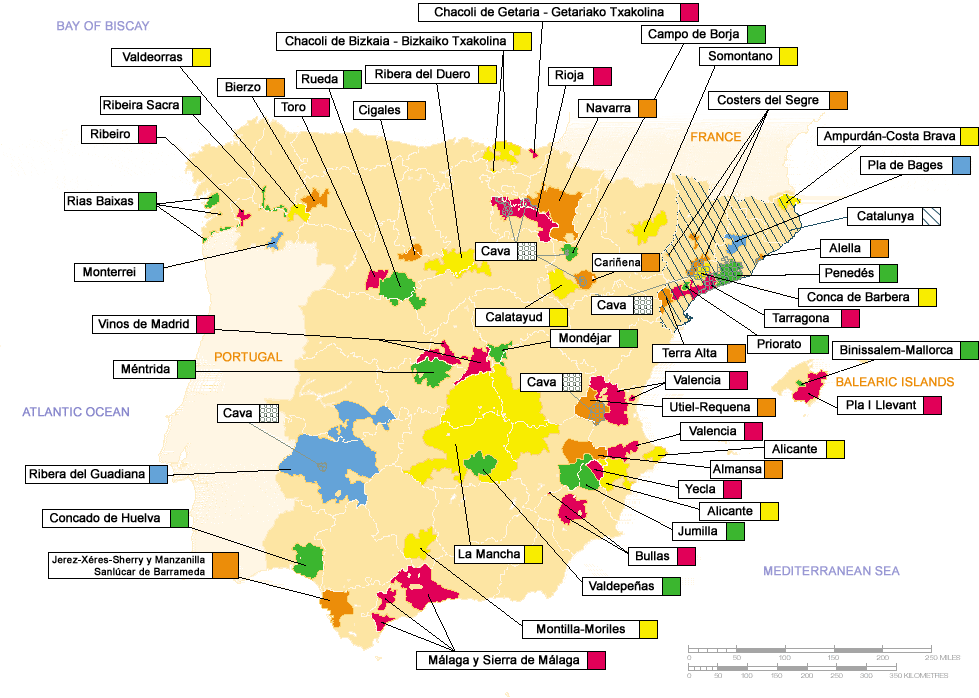
Across a large and arid landmass important rivers cut through the new wine industry of culturally-diverse Spain. From the North runs the Rio Ebro from West to East, slicing through the Rioja, the Navarra and on to the golden schist Ilicorella soils of Priorat.  Out of the northern hills, the prominent Duero empties to the West, past Ribera del Duero, Rueda, and Toro, before becoming the Port highway thru neighboring Portugal. And in the Andalusian south, the Rio Guadalquivir flows under the bright sun through fertile valleys until it spills into the Atlantic, just north of Jerez de la Frontera of the Moorish frontier. It is these important rivers, a handful of others, and the warmth of the almost-perennial sun that has made it possible for Spain to amass the greatest area of wine grape plantings in the world today.

From the Albarino vineyards of Rias Baixas in the Atlantic influenced Galician northwest, across the dry plain that is Don Quixote's La Mancha, and on to the poor, phyloxera-free soils of Jumilla near the Mediterranean coast, this is a very diverse wine growing country. This varied landscape is collectively the world's biggest vineyard, but its irrigated soils here are generally unproductive, and grape yields per acre remain among the smallest in Europe. In this dry climate, vineyard diseases are fortunately relatively few, and these factors combined with recent investment in modernization has allowed Spain to enjoy remarkable improvements in wine quality and value from the last quarter of the 20th century. Spain's four-tier classification system, consistent with EU wine-laws, has the Denominacion de Origen, or DO wines of specified regional standards as the mainstay of its national wine regulatory system. Today, almost 3/4 of all Spanish wines fall into this regionally regulated quality category.

Reserved for its highest levels of proven quality, the Qualified Denominacion de Origen(DOCa) ranking was adopted in 1991, and today only mighty Rioja DOQ and recently elevated Priorat have qualified. Of the more than 400 Spanish grape varieties planted, regional Rioja Alta-Alavesa-Baja-blended Tempranillo(Cencibel) is the principal base of the aged Riojas', while red Garancha Tinta(Grenache) and work horse Carinena(Carignan or Mazuelo) dominate in the distinctive soils of Priorat. Other emerging regions of note include Castile y Leon's white wine dominated Rueda DO, where crisp Verdejo's are of good quality, and tiny Toro DO, producing reds/rose's from Tinta de Toro(Tempranillo) and good whites from Verdeho & Malvasia. In the Mediterranean influenced south, the Murcia region has become notable for good quality reds from the Monastrell(Mouvedre or Mataro)grape in Jumilla DO as well as Yecla DO.

As important as the improved wines from the warm regions are, there is also excitement in the 'Green Spain' of autonomous Galicia, which gets more than 50 inches of rainfall each year. Known principally for seafood friendly white wine blends dominated by Albarino, it includes the DO's Valdeorras, Ribeira Sacra, prominent Rias Biaxas and Monterrei. Along the Rio Mino valley, which runs into neighboring Portugal, Rias Biaxas is further divided into five(5) sub-zones. Catalonia is yet another autonomous region of Spain, where north of Priorat the sparkling wine or Cava center of Penedes DO is found.  Produced in the traditional method, the blended base of these good-value sparklers are the white natives Xarel-lo, and Macabeo(Viura), and even some Chardonnay.
Albariza soils of Jerez

A change to quality from most accounts has come quickly in these areas of Spain, yet it has been the Andalusian Jerez - Xeres - Sherry DO district around Cadiz province that has continued over the centuries to produce the 'neglected wine treasure' that is known simply as Sherry. The dry fermentation of white Palomino(Listan)grapes grown in the regions chalky albariza soils, time-honored Sherry is then fortified, barreled, and then await natures determination as to its classification, fino or oloroso. Once classified, it is adjusted and enters the nursery of the Solera System.  Sweetness and color are added by virtue of dried Pedro Ximenez and Moscatel grapes, to create a fortified wine that is a copy of every bottle of that style that has come before it.

With their regional guarantee of authenticity proudly displayed on the label, young Spanish wines can be noted as Vino Joven. Red wines indicated as Crianza, have been aged at least for two(2) years, with whites and rose's aged for a minimum of a year. Reserva wines have been aged almost twice as long; at least 3 years for reds, and even longer cellaring of  Grand Reserva generally only appears in the best vintages.

In our modern world regulatory cellar aging is only one of the endearing things about proud Spain. Her long wine history, going back to the Phoenicians, and diversely autonomous regional peoples, give Spain strong cultural traditions. The harsh climate adaptations in her vineyards, and the quick modernization of her wine industry instill the admiration of many wine lovers. Combined with a recent French Vignerons Independents report that cited Spanish wine production will soon overtake totals from France, and currently released figures that reflect the export growth in the wines of Spain now eclipsed the 2-billion litre volume mark for the first time ever, there is no better time to explore these Iberian improvements. It is a taste of traditions!
Old Tempranillo vines in Rioja
Salute!


Thursday, April 28, 2011

LESSONS LEARNED; Wine Educators Exam Update

"Do you know that my Mom paid for everything?", my wife offered. The bar had been set. With a Family Easter Brunch, followed by an even larger Easter Supper planned, consumption was to be the order of the day. And I knew that 'everything' did not include wine. "Can we bring the wine?", I replied modestly. She may have suspected that one of my favorite things to do was to value wine shop, and with her approval I made plans to go wine exploring later that week.  And, I was determined not to spend as much as my mother-in-law, bless her. My mixed case(12 bottles) totaled around $104, before taxes, and included the selection of best buys listed here:
  • Cristalino Extra Dry Cava NV
  • Domaine Laurier Los Carneros Pinot Noir 2007
  • Borsao Campo de Borja Garnacha 2009
  • Castano Yecla Monastrell 2009
An almost creamy texture followed its aromas of caramel baked apples and baked bread in the Cava.  This traditional method sparkling wine is the blended product of Spain's widely planted Macabeo grapes, having its bright character and streaming small beads the obvious benefits from the second fermentation in its bottle. The world of Spanish sparkling wine is centered around the region of Penede's in Catalonia, southwest of Barcelona.  Good quality traditional method sparkling wines blended from native grapes, and some Chardonnay, always representing a good value has become its hallmark.  It was perfect for Easter Brunch.


A consistent value producer, Bodegas Borsao in the Zaragoza region, north of Barcelona, specializes in local Grenache, or Garancha.  With its dark cherry color and rich aromas of berries, plums and coffee, its bright character is accented by a kiss of spice. Located in the autonomous state of Aragon, this world class wine growing region along the banks of the Ebro River has been an important crossroads of trade throughout the millennium. Today, Zaragoza produces quality wines from native grapes that pair nicely with roasted meats, rich cheeses, and even Spring lawn games!

Known by synonyms Mourvedere and Mataro, Spain's late ripening Monastrell grapes produce earthy and jammy fruit charismatics as a regional workhorse grape. With its wine history going back to the Phoencians,  Yecla in southeastern Spain, is one of the countries smallest wine growing regions. With is rich, opaque color, this varietal offers dark fruit flavors with a hint of herbal character.  Lamb or game dishes, and especially meats off of the grill have an affinity for the rich character of this impressive value wine. Perhaps even more impressive is the established quality track record of value from this distinguished, sustainably farmed Spanish producer.


California's North Coast Pinot Noir producers over the last decade have firmly etched their strong price points into the marketplace.  Appellation specific fruit sources, such as Los Carneros, the cool region that straddles San Pablo Bay across Sonoma and Napa counties, even more so. Domaine Laurier is an award-winning producer in the Bronco Wine Company family(i.e. Charles Shaw) with quality and value reflected in just about every vintage.  Their 2007 Merlot was an exceptional example. The Los Carneros Pinot Noir offered bright garnet color, with aromas of rhubarb and cherries, and had a weighted body echoing glorious red fruits.  If this quality wine were the North Coast barometer, then others may be simply charging too much!

On Easter Sunday my wife spent the day in the Kitchen.  First it was Brunch, then afternoon appetizers, and finally an early Supper for 25 guests.  I enjoyed the good weather, the catch-me-up conversations, and watching my value wine contribution to the day's events being savored. In retrospect, the satisfaction I enjoyed from the annual 'renewal' event celebration confirmed that this aspiring Wine Educator was learning something.  In spite of recently receiving disappointing results from my latest attempt to become Certified, I could still contribute to any celebration as one of the benefits of my growing world wine knowledge. It is, after all, that knowledge is power, especially in the world of wine!

"In Vino Veritas!"