Showing posts with label Carbonic Maceration. Show all posts

Tuesday, November 25, 2014

GAMAY: Beaujolais' Triumphant Harvest

Autumn vineyards of Beaujolais
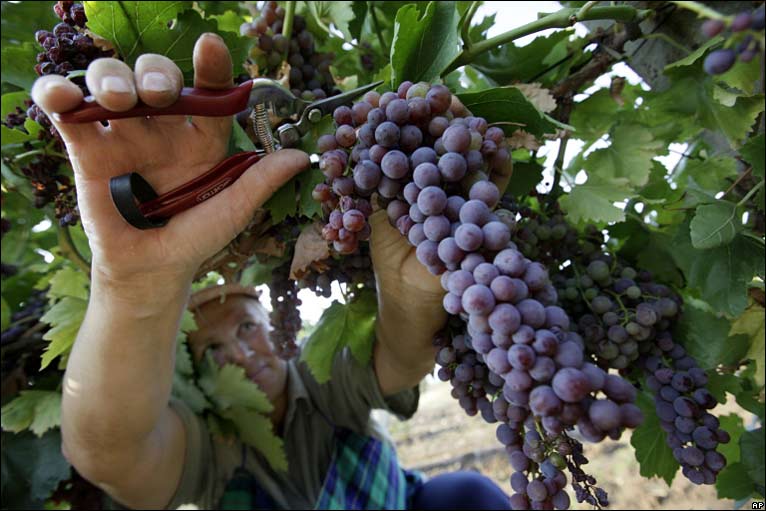
Yellow to brown hues decorate our neighborhoods as seasonal trees loose leaves and carpet the streets.  In the nearby vineyards, grapevines too display a change in color as they loose the green pigment, chlorophyll, producing a temporary tapestry of autumn shades. Here, grapes fill the wine cellars as this annual right of passage displays such outdoor beauty, only to drive its winemakers indoors. Weeks before the arrival of Fall, far away vineyard managers were triumphantly calling for an early harvest in the Beaujolais vineyards of eastern France.

Growing in popularity, early ripening Gamay(Gamay Noir à Jus Blanc) was ready for its collection. It had been a challenging growing season, but that was nothing when compared to its 'criminal' past. An offshoot of noble Pinot Noir, Gamay has found a home south of Burgundy, in an area barely 55km long, outside of the Rhone department. Ostracized from its native homeland, it had adapted quickly in the granite based soils north of Lyon. Historically, the Romans had planted on these hillside communes of Brouilly and Morgon along the established trading route. This region had less importance, but shared its agri-development during the Dark Ages sitting between nearby Burgundy and the Rhone.

Being less challenging to cultivate and earlier in ripening than its fickle parent, Pinot Noir, widely planted Gamay had run afoul of the law. It was the curse of the Philippes',  when in 1695 Philippe the Bold, then Duke of Burgundy, outlawed Gamay in the increasingly prestigious Burgundy zone, pushing plantings further to the south. More than two generations later, Philippe the Good issued yet another edict against lowly Gamay, sealing its fate to the lesser department of the southern hilly region demarcated today. There it languished, only to became known outside of the region once rail connected them to Paris near the end of the 19th century.

With the Massif Central to moderate its semi-Mediterranean climate, this 34-mile strip, larger than any one region in Burgundy, produces today more than 13 million cases of wine from the valleys and foothills west of the north-south River Sao'ne. Gamay is the bastard cross, a progeny of Pinot Noir and white Gouais, an ancient variety that long ago traveled from Central Europe. Gouais most famous offspring is Chardonnay, which was infamously cherished by the then nobles of Burgundy.  Here, the broad appellation is simply, "Beaujolais AOC", where almost everything qualifies, producing simple wines for the bistros of Paris. Advancing in quality, there are more than three dozen villages, mostly to the south of the region, that qualify for the Beaujolais-Villages AOC. If the grape reflects its site, here tended along a flatter terrain it is clay that becomes more prominent in the soils, producing simpler wines.
2014 Harvest under threatening Beaujolais skies
In the North of the region, 10 distinctive schist-granitic soiled hillside villages produce the pinnicle of Beaujolais, designated as 'cru'. Grapes from these sloping hillsides offer the best expression of Gamay, producing more full bodied wines from lower yield vineyards. From the deeper colored, long-lived AOC's of Moulin-à-Vent, Morgon and Juliénas, to the fruity, well-balanced wines of Côte de Brouilly, Chiroubles, Chénas, Saint-Amour and Fleurie, this is Gamay country. It is the 'cru' Beaujolais that can produce exceptional wines; wines that are bright, mouth-filling, palate lingering and cellar-worthy for comparatively very reasonable prices.


For this 'criminal' grape, outlawed to the hills, a grape of thin skin and a low density of tannins, this past growing season was unseasonably cool, and rainy throughout the summer. Further north,  Burgundy was hit by severe summer hailstorms, producing the smallest crop in many years.  Coupled with increasing demand from Asia for its already scarce Pinot Noir and Chardonnay, consumers should expected price increases of up to 15% for the wines of Burgundy, according to many estimates. Further south, the cool, wet summer in Beaujolais was salvaged by warm, sunny ripening conditions in early September, bringing again a triumphant early harvest. As a result, the pricing quality to value represented by quality Beaujolais will continue to be available to discerning consumers.

To keep its cherry-bright, low-tannin personality, most Beaujolais today is the result of a controlled fermentation called, carbonic maceration; a whole cluster evolution in a carbon dioxide rich pressurized environment.  Uniquely, fermentation takes place within each individual berry, producing an aromatic freshness, often associated with the notes that remind us of bubble gum. The resulting personality makes these quality wines perfect for the social gathering of the many flavors on a Thanksgiving table. Recent Beaujolais Village vintages have offered consistent quality as they ride on the marketing coattails of immature Beaujolais Nouveau, but it is in the delicious cru where this Gamay criminal annually triumphs.

Happy Thanksgiving to All!
Salute!

Tuesday, December 31, 2013

PAIRING: More than 2 Together?

Bright sunlight, clear skies and a neat garden made the lunch special.  We sat on the comfort of the deck, around our Summer table, although it was mild and late November!  Fettuccine Carbonara and a garden salad with a mild citrus vinaigrette danced here with an inexpensive White Burgundy from the 2009 harvest, still its briny acidity dancing in the mouth.
Anderson Valley AVA Hilltop

It had blossomed into a celebration of sorts.  A strong recovery after a serious illness is a good reason to celebrate, particularly when being in the Thanksgiving mood.  The Society of Wine Educators also had recently given their official approval of my examination of Wine Faults & Imbalances, thereby allowing progress to the Presentation Skills Demonstration.  The journey's end may be near, and that too is a reason to celebrate.  It is the Season, after all.

Refreshing Riesling likes acid, salt and oily pairings.
Merchandising, those Holiday parties, and the general euphoria of the good cheer expressed by friends, by family, and even by strangers, are the hallmarks of the weeks that followed.  It is the Season, after all.  Even as we were surrounded by the warmth of well wishers, my focus continued to return to the urgent need to submit a declared subject and an outline to the Society for my Presentation Skill video exam. One of six(6) subjects were available at this time, and I found myself only considering those that I thought that I had some confident command over.  But, the more I read about Carbonic Maturation, or the Wines of Sicily, or even White Burgundy, the more unsettled or unsure I found myself.

Demonstrating command of the subject matter with the ability to coherently present understandable details about the uniqueness of Chablis, or the white Aligonte' grape would certainly make Burgundy interesting. And the idea of being able to practically convey a fermentation inside of a grape berry, as is the case with carbonic maturation, actually made my head hurt a bit. Alternatively, having more than 3000 years of winemaking history, the paradise that is Sicily was definitely a ripe subject to consider.  Most wine drinkers have probably heard of its fortified Marsala, but what about the islands prominent red, Nerello Mascalese or even Frappato? I would have to declare a choice and develop an outline soon, but which one?

Those closest to me say that I work well under deadlines, and that is exactly what I have created.  The Society will offer new subject matter choices in February, but I really do not want to delay this attempt at advancing my Certification.  At this point, the production of the video seminar is still in the distance, but it does little harm to put energy into lining up a videographer, a production setting and an audience of at least six(6) supporters.  It does little harm, I think, to put those carrots in front of this horse.  Our newly launched service web site: www.your-wine-guy.net, is just one of those hopefully positive influences that will move this quest for certification forward.

As much as we look forward, this is also the time of year when we look back. As I reviewed our 2013 wine impressions, there were a few notables that stood out as being some of the best wines enjoyed this year.  All of our wine samplings will be found on the popular wine lovers site: http://www.snooth.com/my-wines/InWineTruth
In no particular order, the standouts for the year include two French and two Spanish treasures:

  • Resso Garnacha Blanca 2011 from Spain was a delight, with its lively, tart
         fruit body and racy acidity it was a wonderful lunch time, a chicken and seafood
         refreshment.

  • Mayor de Ondarre 'Reserve' 2006, also from Spain(Rioja), proved to be everything we wanted in a rich, food-friendly red wine.  It has ripe, dusty black tree fruit character with candied spices that linger with an integrated length on the palate; perfect for what we braised or smoked because of its firm structure and earthy richness.

  •  Domaine du Garde Temps Rose' Tourbillon 2011, produced in southern France, proved to be a delight, with wispy, lively white strawberry and Rainer cherry notes and a very long bright finish.  A terrific sipper from the land of rose' that worked with summer salads and Cajun fried chicken. Yum!

  • Pierre Sparr Cre'mant d'Alsace Brut Rose; gorgeous strawberry and white cherry notes dance across the palate with balanced acidity.  Stop the bus, what a terrific traditional method sparkling wine that pairs with almost everything!

    These wines were so food friendly, enhancing the meals by either a complement or a contrast to each dish.  Each side dish placed the notes differently(as they should), but each added to the flavors and the enjoyment of the meal.  With good times, or lovingly prepared food or good friends and good value wines, it is always the perfect pairing when we can get more than two(2) together!

    Happy New Year, and Salute! 


Wednesday, October 26, 2011

BRAMBLES: Harvesting Wine Questions

Muscadet from the Nantes of the Pays de la Loire region in Brittany or a cool vintage mid-Loire Vouvray could have been the recent Wine Educator's Certification Exam dry white wine control sample. Red choices included a recent vintage Carneros Pinot Noir and a large producers Beaujolais Village, that may have been the result of carbonic maceration.  The challenge was to determine which was which in a field of other similar varietals. Weeks after the benchmark exam, these and many other questions persist for this aspiring Wine Educator.

Loire Chenin Blanc
Muscadet, also known as Melon de Bourgogne,  is the volume leading grape of France's Loire river valley region. Vouvray is a wine region east of Tours, producing mostly wines from the high acid Chenin Blanc grape in styles that can be in a range of dry to sparkling. This was going to be a tough identification, because both were austere and green fruit influenced. Isolated from the other red wine samples, I knew Napa Valley's Carneros appellation as a cool climate region, known for some of the North Coasts best Chardonnays and Pinot Noir's. But recent harvests have been cool, resulting in high-acid wines that may not exhibit the ripe richness of any typically characteristic fruit. In effect, they can be more Gamay or 'Beaujolais-like'. To complicate matters, the Gamay vineyards of the most-southern Burgundy region, enjoyed a warm and rich harvest in 2009, producing more wines that were actually resembling Burgundy AOC Pinot Noirs. As with other wine exams, choices had to be made based on accumulated knowledge and perception. That is not unlike the annual choices premium grape farmers make every harvest season, especially this mild year.
Cote du Beaune Pinot Noir Harvest

In the weeks of this year's cool and wet Spring, local vine flowering and berry set were challenged. Fewer flowers, many knocked off by seasonal rains, poor pollination and the resulting shatter of a weak berry set indicated early on that the years harvest would be drastically affected. Trying to farm my few Sonoma County vines sustainably, an outbreak of a fungal powdery mildew, encouraged by cool temperatures, veiled Springs newly grown canopy, just as my vine curtain's fruit was forming. Outside of the seasonal rains, I purposely stopped supplemental irrigation, the canopy was then de-leafed to improve air circulation/exposure and an application of a sulfur mixture was applied to abate the fungus outbreak. Then I crossed my fingers.
Bortrytis Noble Rot or Grey Mold
The first of week of October brought un-welcomed rains to Sonoma County's grape crop. Local growers were finding their Chardonnay crop still under-ripe, with levels of sugar stuck well below the optimum for an anticipated harvest.  It was now a waiting game.  Some fruit was already showing signs of the bortrytis fungus, or noble rot, where the moldy skins break down and remaining sugars concentrate.  This would be great for Semillion, but a blight for the counties heavy volume Chardonnay crop. In recent dry days, the winds blew thru to dry the thin-skinned fruit clusters and the mild sun warmed the air.  But would it be enough to hold back the fungal spores that were waiting for the chance to thrive in our Chardonnay vineyards?


Magic in the cellars of Bordeaux
A few weeks of dry weather and sunny skies have given us recent optimism here in wine country.  With more than half of our counties premium wine grape crop of 65,000 acres harvested, mostly thick-skinned, late season ripening varieties like Syrah and Cabernet Sauvignon remain to mature. Due to fewer warm days this season and the early rains, the optimistic Napa Register recently reported that this years less-ripe, lower alcohol wines could be the makings of a spectacular vintage. Other grape farmers chimed in following an article in The Drinks Business, which claimed this year's rains "ruined" the harvest. As expected, the responding growers thought the idea too simplistic and too generalized, in part because they profess the ability to develop wonderful lower alcohol wines from grapes of optimum flavor and acidity.

In point of fact, great wines are made in every vintage, and great winemakers will consistently get the most out of the quality fruit they receive. Our global evolution in viticultural science, vineyard management practices and enology simply means that winemakers today have better tools and understanding to produce quality wines.  The proof will be in the bottles of the 2011 vintage.  But not in my ornamental grape garden.  The ripening grapes that were not attacked by Grey Mold have now been eaten by migrating starlings. Overall, I think it will be a much lighter grape harvest this season.

Sunday, August 28, 2011

VINIFICATION: Is it Wine Yet?

Bulgarian Grape Harvest
Sun, soil and water combine to nurture the physical and physiological ripeness(ripe tannins) of a vineyards wine grapes where sugars and acids are in balance for the winemaker. Once extracted it is just fruit juice, but, it becomes wine as our harvest season begins anew when the inevitable variables of nature are controlled in the cellar. Truth is, great wine comes from preserving the integrity of great fruit from well managed, sun-drenched vineyards. Vinification needs great viticulture. It is the wine-grapes 6-carbon ferment-able sugars, glucose and fructose, that get converted into carbon dioxide and ethyl-alcohol by hungry little enzymes of yeast, either native or cultured. Five(5) carbon sugars remain un-fermented in solution, but are generally unrecognizable in wine. A volatile, heat-generating process, a controlled alcoholic fermentation produces additional compounds that reside in the finished wine, such as acetaldehydes, phenolics(anthocynins), and even a little byproduct of sulfur dioxide. But, I'm getting ahead of myself.  The winemaker's choices of controlling many winegrape variables start early in the process.

In the cellar, it quickly becomes about the choices made by the modern winemaker; about their ability to control what nature provides. Do they de-stem the berries or ferment the whole clusters of fruit increasing the measure of air circulation and bitter tannins?  Will there be a pre-fermentation 'cold-soak' or cold maceration to soften seed tannins, enhance extraction, color, and aromas?. If so, for how long? Employed mostly on Burgundian varietals, this procedure still has its critics that discount its winemaking virtues. One thing is for certain though, a controlled cold maceration slows down the cellar process, extracts water-soluble pigments, and gives the wine maker more time to control a few variables. Extracting as much flavor or character is paramount, as well as preserving the color and the right balanced levels of the many acids in the young wine. Prior to fermentation, acid and sugars are measured to calculate the character of the finished wine.  Fragile white wines ferment just the juice of the berries in cooled temperatures and with very calculated, limited exposure to oxygen to preserve aromatics and freshness. Red wines by comparison are fermented on their skins to extract the character of color and structure, and benefit from oxygen exposure.
Chardonnay ready to Press

Yeasts are the catalysts of alcoholic fermentation in the cellar, so a yeast selection that produces greater control of the outcome(cultured) may be beneficial over native(wild) yeasts that live on grape skins, which can produce higher levels of alcohols and acetaldehydes. A cooler fermentation for white wines would follow a press, a juice settling(de'bourbage) and adjustments to acid or sugar(chaptalization) levels. A secondary fermentation may be introduced following primary fermentation here, changing the tart malic acids for the softer lactic acids(malolactic). And then in a series of steps intended to develop complexities and clean-up the new wine, it is racked to remove the dead cells(lees), adjusted, clarified and stabilized prior to its blending and bottling. Some white wines, notably Chardonnay, become rounder, more complex from being fermented in oak barrels rather than the more common stainless steel tank.

A warmer red wine fermentation is engaged prior to pressing the solids, where the hotter temperatures aid extraction of critical wine elements like color and flavor components from the pulp and grape skins. A malolactic or secondary fermentation is introduced to most red wines here to soften its coarse and aggressively tannic nature prior to an extended maceration which can include aerating the wine, and pressing off the juice. A calculated aging schedule in barrels allows for evaporation(concentration) and oxidation of the new red wine, as well as the softening of its course tannins, which pulls suspended particles out of solution and adds the dimension of oak flavors.  As with white wines, red wine clarification and stabilization is needed, and can happen before, during or after the aging process. Alternative whole-berry fermentation or Carbonic Maceration is practiced in oxygen-free environments where the freshness of red fruit is to be preserved. Typically lower in alcohol, tannin and pigments, the natural sugars in these grapes are broken down without the intervention of yeasts, resulting in fruitier wines like Beaujolais Nouveau.
Carbonic Maceration Tanks

Along the way, the winemaker uses a number of steps to control variables, such as sulfur adjustments to control yeast action, eliminate spoilage or browning. The new wine can be further processed by using techniques like heat or cold stabilization to remove unwanted proteins or to remove tartaric acid crystals respectively. Fining agents which bond to suspended particles, and micro-filtering give winemakers yet another way to clean-up and control the many variables in the winemaking process.  It is all about timing and calculated choices in a series of  time-tested steps that preserve the integrity of the vineyard fruit prior to bottling for every winemaker.

Aeration of the wine 'cap'

As you expect, many variations exist within the process.  Arresting the fermentation prior to all the sugars fermenting will create a sweet wine.  If achieved by the addition of alcohol, you have a fortified wine(VDN). Should the winemaker capture the escaping gas(CO2), either in the bottle or a tank, a sparkling wine is the result. Exposing an aging wine to air can create a slowly oxidized wine(Sherry), or heating the finished, fortified wine to create something unique, like a Madeira.  Making fine wine is not really a simple process.  It is the wonderful marriage of science and art, that advanced dramatically thru the development of the agricultural  sciences in the last half of the 19th century. Controlling what nature provides allows the modern winemaker to determine when the best grapes of each harvest become the best wine he can create.
Unclassified Pomerol Cru Merlot

Only then is it wine!

Cheers! 


Monday, June 6, 2011

BEAUJOLAIS: A Part & Apart

At the southern edge of Burgundy, situated between Macon and Lyon, the red Gamay grape grows like no where else in the world. This landscape produces more than half of the wine in this wine Mecca known as the region of Burgundy. Yet, some proud Burgundian's don't consider Beaujolais part of Burgundy at all, even as they share the landscape south of Macon(Pouilly-Fuisse). These neighbors are even historically and physically connected by a navigable waterway, the southerly flowing River Saone. Beaujolais is technically part of the Rhone Department to the south, but administered by Burgundy to the north.  It is distinctly Beaujolais, a part of more prominent regions, but remaining distinctly apart.
Morgon Vineyard
Wine grapes came here by way of the Romans, who planted vineyards on the trade route slopes of the Saone Valley in the first century.  In the Middle Ages, the Benedictines brought order and developed a broad vineyard system throughout Beaujolais. The regions fate was defined later when Duke of Burgundy, Phillipe the Bold, issued edicts in the late 14th century banning the cultivation of the Gamay grape in Burgundy's heartland, thus fatefully pushing it southward to the granite based sub-soils where it thrives today.

As in many other wine regions, Beaujolais best vineyards lie in the well-drained terroir of its northern shale and granite hillsides.  But unlike other regions, the fortunes of Beaujolais are based on only one thin-skinned, high-density planted grape, Gamay. Hand harvested, most of this regions Gamay wine is produced by semi-Carbonic Maceration, and sold as fresh, lively Beaujolais Nouveau from the third Thursday each November.  Grown mostly in the clay-based soils of the southern region, it produces lighter, tannic-less wines of fruity character,  often described as "bubble-gum" or "pear-drops". This noveau wine has had considerable global marketing success, producing about a third to a half of all Beaujolais wine, yet is also known as 'Vin de Merde' by some prominent French wine critics. But the best of Beaujolais, its Crus or growths, continue to be produced in the more traditional fermentation.
Vin Nouveau et Japan


Its Grand Cru wines from Cote de Brouilly or Moulin-a-Vent can age for a decade or more in a good vintage, but it is the exception for Beaujolais. Of its twelve appellations, Beaujolais, Beaujolais-Village and the ten(10) Crus, most of the everyday wines consumed in the bistros of Lyon are produced by the regions many co-ops and negociants. For the most-part, these are food wines offered for informal immediate enjoyment.  But even everyday wines need their champions. Given the title, the king of Beaujolais, negociant Georges Duboeuf,  alone produces about 10% of the regions wine.


Ten of 39 villages are designated Grand Crus, producing about a quarter of all the regions wines. Wines from non-Cru or multiple villages can be labeled Beaujolais-Villages, with the Beaujolais AOC the blended, generic base classification.  But the glory of Beaujolais comes from the vineyards found in inhospitable and rocky outcroppings above these ten(10) notable villages.  North to South the Beaujolais Crus villages are:
  • Julienas and St-Amour
  • Chenas and Moulin-a-Vent
  • Fleurie and Chiroubles
  • Morgon and Regnie
  • Brouilly and Cote de Brouilly
Based on the marketing success of this region's vin nouveau, it is very possible to discount the more serious wines of Beaujolais.  Similarly, it is almost impossible to even think of proper Burgundy or Northern Rhone producers considering the same promotional scheme to move product to consumers. But this is Beaujolais, where fortunes are based on only one grape variety no one else wanted. Beaujolais, where you are considered as a part of agricultural and political regions that segregate and want no part of you!

In my limited experience, the concept of terrior, or unique environmental qualities, is expressed very clearly in the Grand Crus of Beaujolais.  Each of these ten(10) growths have consistently distinctive character that makes a Brouilly full, fruity and supple or a Fleurie opening with a intensely floral and fresh fruit aromas. A seductively fruity bouquet combines with St. Amour's fragrant flavors, to contrast with a Morgon's sturdy and compact fruit personality.  In its current release, the vintage of 2009 has much to offer wine lovers.  These fine wines have been described as "intense" and "seemless", from what  may be one of the region's most expressive vintages.  Today there may be no better time to get into being 'a part' of something no one else wanted!

Cheers!