Showing posts with label Winter Pruning. Show all posts

Saturday, December 29, 2018

BRAMBLES: Holiday Surprise!

Baby, it's cold outside, but winter pruning awaits
 Lucky boy. Over the course of these current holidaze, there are always surprises in store for the domestic wine lover.  It could be that long lost friend found at a local party, with a chance to catch up on the time that was missing.  Or, that surprise gifted bottle, festively dressed, for which you find yourself unprepared to reciprocate at that particular moment.  And, it may also be that discovery of taste, something fantastic in your wine glass that you have never before had a chance to explore.  Indeed, this time of fellowship and good will, a time of seasonal joy and warming fires, may just offer the wine lover who has gathered with good natured friends an unexpected and eye-opening surprising wine holiday.

In the north of Italy, framed by the alpine foothills and the lakes Como & Garda, lies the ancient Lombardy vine region of Franciacorta DOCG. In spite of making wine here for thousands of years, this important region has a relatively young sparkling wine tradition of producing traditional method sparkling wines(second ferment in bottle, just like Champagne).  Only designated DOC for its wines in 1967, it became the first Italian region to regulate the laborious bubble process just back in 1995 when elevated to DOCG status.  Only regional chardonnay, pinot blanc and pinot noir are permitted, and the minimum 18 month lees contact in bottle is greater than that required in the traditional sparklers of Champagne AOC.  This typically results in fine bubbles, and a yeasty, but refined, mouth-watering signature.

Like soldiers on a parade ground, the stemmed flutes were lined up as the cork escaped from the celebratory bottle of non-vintage Franciacorta.  In the golden glass, beads of tiny bubbles streamed to the top.  With anticipation, upon our first whiff of its bouquet it was apparent that this wine was faulted by TCA(trichloroanisole), a natural chlorine based compound that mutes the nose and mouthfeel, promoting a flat and musty character akin to damp newspapers or 'wet dog in a phone booth'. Despite its appearance, the 'corked' wine had lost its magic, and as a result, muted the hopeful celebration.  As such, it was again a reminder, a holiday surprise that we are always hopeful to avoid in such gleeful company.  Faults can occur when our excitement and our spirits are high.
Summer Chardonnay of Franciacorta
With shopping bags at your feet, sliding down the restaurants' wine list, one may dismiss selections that are more than twice the cost of any entree, until finding a familiar name.  So it was with an Anderson Valley AVA pinot noir selection from a quality boutique producer, Phillips Hill. Perhaps it was the warm hospitality found inside the old apple barn off Hwy. 128, or the distinctive, artsy labels, and certainly, the high standards of quality enjoyed across the winery's portfolio selections. But, it resonated a trust and anticipation that was rewarded when a 2016 vintage Boontling Pinot Noir, Anderson Valley is presented at table.

Shimmering garnet in the glass, its pronounced aromas fill the head with the scent of racked dark seasonal fruits.  On the palate, it was a broad, but refined range of cherries, red currants, and a hint of baking spice that evolved across the mid-palate to a deliciously lingering finish, all held together by its brisk acidity.  The wine represented all that's grand about this cool region; the diversity of its soils and micro-climates, it's high standards of expression from a blend of local pinot growers'.  Bites of the rabbit casserole at table sang harmoniously with the pairing, lifting spirits bright.  Oh, what fun it is to find in one's glass a delight that is so much more than just a beverage.  It's a warm memory, a whimsical escape, a dinner companion that's a joy to share, and, a delicious Holiday Surprise.

Salute! 

Wine-Links:
 https://www.franciacorta.net/en/wine/typologies/
 https://www.avwines.com/

Tuesday, February 28, 2017

BRAMBLES: Climate Changes, Values Found


Under a bright sun the thermostat displayed around 70 degrees that cloudless afternoon.  To take advantage, I gathered lunch for the deck, a lean seared steak salad with kale, peppers, and tomato, and presented it to a personable glass of 2009 Ribera del Duoro from a reliable Old World producer.  As the ruby jewel shimmered in the sunlight, I thought things were just about perfect at that satisfying moment.  It was the end of January, and I was not in the Southern Hemisphere, but in the North Bay's wine country!  In the days that followed temperatures again dropped and the skies clouded. And then it poured; contributing to one of the wettest January's here in recent recordings.

That wet pattern continued thru February, taking the region fully into the season of power outages, flooded roads and mud slides.  Even as measured rainfall is currently better than twice seasonal average here, throughout the state our generous snow pack may finally be signaling the end of the current cycle of recent years of statewide drought.  Importantly, a lesson for our agriculture will have been the cumulative benefit here: agrarian efficiencies to produce more with less water. Residential users too have now had years to practice conservation, training the habits of our once water wasters. During a few brief, but sunny breaks, vineyard workers were able to prune vines to direct seasonal growth, and recently a sea of wild mustard has advanced on many beautifully neat vineyards throughout this muddy region, offering the returning promise of spring.
A dry/off-dry Riesling pairs nicely with Asian dishes
Even on these dark winter nights, we can escape to a favorite restaurant in search of a wine value.  Restaurant(on premise) ringers can usually be found in the middle of the wine list.  Here are, not the cheapest, nor the most expensive wines;  often listed as an 'alternative' or as 'interesting' selections.  Many times they are varieties or blends that are under the radar, from regions that don't have the marketing clout or prestige of, say, Bordeaux or Chianti Classico.  Selections from food pairing varietals like Albarino, Arneis, or Chenin Blanc rarely disappoint.  So too, red Rhone blends, Monastrell(Mourvedre) and Garnacha(Grenache) from Spain's Alicante or Jumilla regions(DO) can offer an expressive marriage with regionally inspired foods without breaking our bank.  Additionally, a wine-by-the-glass can offer diners an inexpensive way to test ride one of these hidden gems. Or, ask for a taste. After all, restaurants should be in the business of introducing you to their food-friendly wines which were orchestrated(in theory) to support their menu.

You may not even have to leave your easy chair to find a current wine value.  On line, flash marketing sites are a growing and increasingly competitive commodity. Some flash models will typically just move the featured sales paperwork that allows an individual brand to ship direct to consumer(where shipping is allowed).  Others will pop a notice on your phone or e-mail and then ship from their own warehouse inventory to control the efficiency of selection and process.  These numerous sites offer discounted wines that move from a secondary market, like a wine outlet virtual store, where some discounts can exceed 50%!  Shopping around to find the best daily value and service is recommended, as site inventory, vintages, shipping costs and discounts can change quickly.

At our local retail shops(off premise), knowing that the middle tiers are the volume shelves fought after by large corporate wine distributors and their big, volume brands, values can be found if look at the top and bottom shelf selections.  Smaller shops seek customer relationships, and often assist consumers in searching out values with knowledgeable staff from their recommended though limited selections.  But, that can be a good thing. The more often we visit these valuable merchants the greater opportunity to access their individual and unique wine world palates.  Even brick 'n mortar wineries can offer values to the visitor with annual end of vintage sales and event discounts.  Plus, it is a good way to identify if the character of the wineries stylings excite our unique tastes.

Today, after a few days of returning sunshine we're beginning to dry out, as the invitingly bright outdoors warm up.  It is going to be a great day to visit a local wine shop, or perhaps enjoy a patio lunch to search out the ever changing sea of wine values.  Even as our seasonal climate continues to change here, the wine values found remain a deliciously adventurous constant.
Cheers and Salute!

Tasting Values:
Cantele; Salice Salentino DOC Reserva 2013 - blackberries and spice feels rich in the mouth.

Bon Temps Roulet!

Wine Links:
https://www.kermitlynch.com/
https://www.lot18.com/
http://www.wine.com/
https://wtso.com/

Wednesday, March 12, 2014

BRAMBLES: Waiting for Winter

Mission Ridge, Santa Clara County
Drought seems on the surface natural for grape vine 'dry farming', the sustained use of residual moisture in soils accumulated during the rainy season for crop production during the dry season.  Local grape growers had a relatively dry Winter in 2012-13, so water tables and reserves were already low.  January and February here were without significant rainfall, and saw to it that our hills and vineyards stayed golden brown. Now almost in mid-March, we here are still waiting for needed Winter rains, as rainfall amounts are about half of what they were this time last year.  Dormant grape vines store water during the Winter, but this year there is again, not alot to go around.  Recently, after the storm door had opened slightly, we took a short needed road trip to a drier, warmer climate south into the Livermore Valley AVA.

Just over the San Francisco Bay hills, the east-west oriented Livermore Valley was basking in sunlight. Spring bulbs, early season wildflowers and flowering shrubs splashed color across the backdrop of newly green hillsides. It was beautiful!  The valley is home to about 50 wineries in a ten(10) mile stretch, dotting an increasingly suburban landscape.  Early names like Wente, Concannon and Murietta's Well are prominently part of this areas California viticultural history from the pioneering 1880's. The AVA is today part of the larger Central Coast AVA, and its sub-region, San Francisco Bay AVA, as the Bay's influence can be felt by the cooling winds that race across its rolling hillsides.

Here the smaller producers open their doors and get by with direct to consumer sales and retail placements in local restaurants and bottle shops, but our first stop was at a large, nationally distributed brand, Concannon.  Recent investment into the brands production and visitor facility brings out the family picnics to their expansive and creatively landscaped grounds, as well as the limousines of younger wine lovers who toy in their tasting room. Creatively, the long established brand also has a restaurant and wine bar that serves local & import brands in addition to their own.  During our recent tasting, our favorite was the Concannon 2008 Petite Sirah with its mouth-filling black fruit and fine grain tannins.
 
Way back in the early 1880's, a nursery-man from southeastern France, Dr. Francois Durif, crossed a workhorse variety, Peloursin, with a late-season ripening indigenous grape, Syrah.  He named his grape progeny, Durif.  James Concannon planted the new variety, now commonly known as Petite Sirah, on his estate at the turn of the 20th century, and the rest is as they say, history.

We did not have to travel very far to find the down-home Mitchell Katz winery; a horse-drawn surrey was in the gravel parking lot and locally made sausage were on the grill.  Our tasting included several adequate white & red selections, but the consensus favorite was the fruit driven bing cherry notes in the 2010 Abbout's Acres Merlot. Here we conversed with a local vineyard owner who was staking his sweat and fortune on the minor variety Sangiovese planted nearby. He announced that he had just returned from a much needed vineyard pruning, only to find that his freshly cut cane's did not weep a drop. "They need a good soaking", he cautioned. As the afternoon winds picked up we drove a short distance into the hills and across another gravel lot to the McGrail Winery.  Easily the best reds of the day were found here with the 2008 Picazo Proprietary Red(a Bordeaux blend) and a solid rockstar of a young, herbaceous Cabernet Sauvignon.

Gravel is big here; you can see it in the log row vineyard soils.  But most noticeable was the advanced new leaf growth in row after row, a sign that bud break occurred very early here in this warmer inland environment. Just as in the wine valleys above the Bay's north shore, we are all waiting for Winter. With no rain in the regions extended forecast, it would seem to be a good time to plan a visit to a few more of these down-home vintners.  Livermore Valley Wine Country's 6th Annual Barrel Tasting weekend is on March 29/30, with 32 open-armed venues ready to sample and to entertain winelovers.
Awakening Bud Break
With Spring just a few weeks away, I'm also waiting for the much anticipated results of my submitted teaching video to the Society of Wine Educators.  Waiting seems to be the constant theme for this Winter.  We are waiting for the rains, waiting for the seasonal chill, and waiting for consequence of our many years of wine study.  Perhaps that is the wonderful and curious thing about Winter; it is the sustained anticipation of a renewed growth season... just like the dry farming of our winegrape crop.

Salute' and Cheers!!

Sunday, February 26, 2012

BRAMBLES: Mid-Winter Faults


Warm temps locally force blooming cover crops
Out of Balance. Typically, wines that are 'out of balance' have at least one compositional fault, sometimes more. With the upcoming Society of Wine Educators Wine Educator exam around the corner, I know that part of the test will be on the blind identification of numerous wine faults. Outside here there is bright sunshine, unseasonably warm temperatures, and an extended forecast that's mostly sunny.  This being mid-winter in the mid-upper latitudes of the northern hemisphere, the purposely tainted wines that I practice with are not the only thing seemingly out of balance.

Extended forecasts here in wine country predict day time temperatures above 60 degrees and little if any rain on the horizon.  Sonoma County will see about 30" of rainfall in an average year, most of it irrigating our vineyards in the December thru February months.  Season(July 1 to June 30) to date rainfall this year has been just barely around 11 inches, with most of it falling in a five(5) day period mid-January. Here at home, the last three sunny days have not been below 75 degrees, setting historical records. Most seasons we get about 5" of rain fall in February, but not this season.  We will be fortunate here to do better than 1.0 inch total rainfall for this entire month.  Because this is the dormant season for grapevines when they absorb most of the sustainable water they need, local vineyards have been tapping local water supplies and irrigating. And with the arrival of Spring, and its welcomed bud-break weeks away, there are sure to be watchful growers and even more water local river/reservoir usage misting potential frost damage.
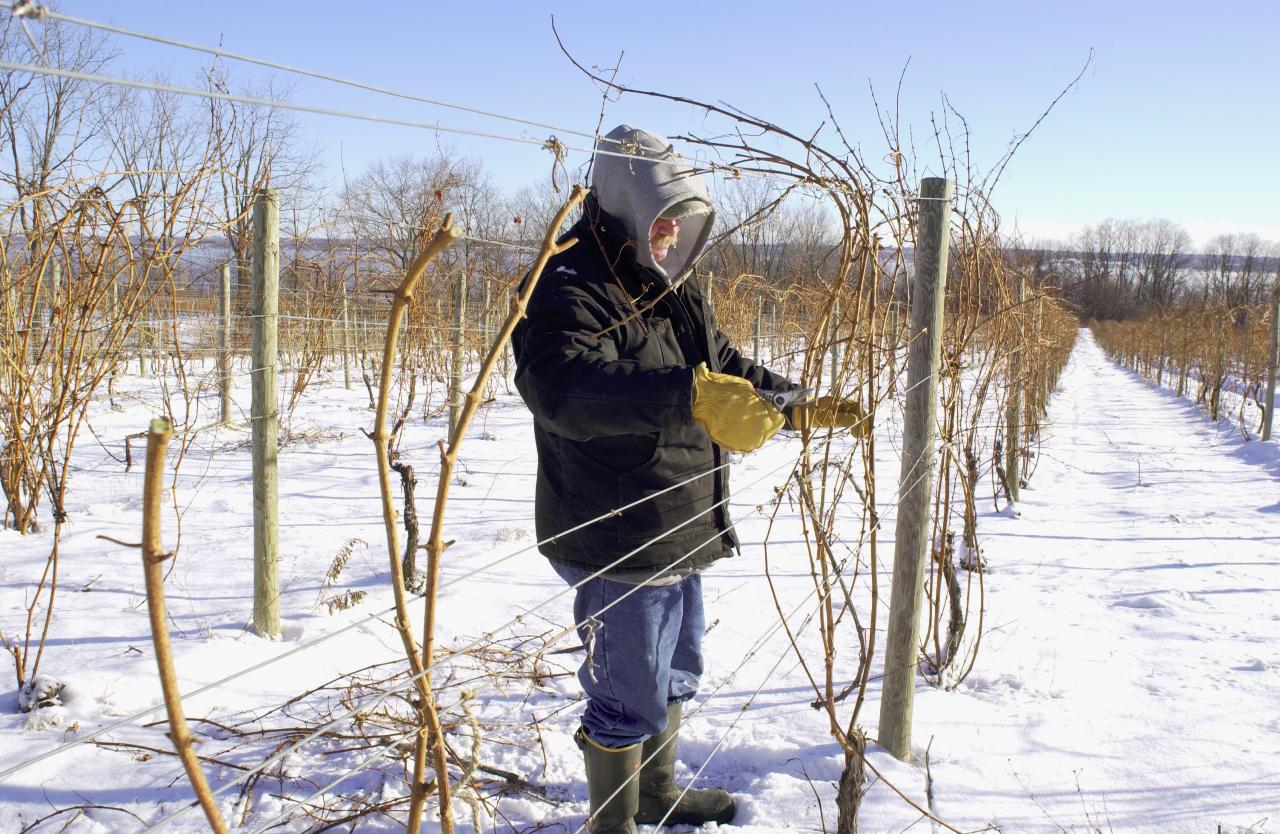
Northern Latitude mid-winter pruning of vines

Out of Balance, too, are wines that have one or more faults, or a problem with their composition.  These maladies can appear as off aromas or unappealing taste(s) in the tasters glass. Because wine is a result of chemical changes in grape juice, the precise control of these changing element levels can keep a wine in balance. However, cooked wines(lifeless or stewed) which often have been overheated or TCA 'corked' wines(aromas of wet cardboard) can be unknowingly served to the willing consumer. Of the many challenges to making good wine, there are a number chemical in-balances that remain prominent.

  • Acetaldehyde is the result of oxidized ethanol(alcohol), and creates a straw-like, almost acrid character that may increase a wines complexity while keeping it unbalanced.
  • Brettanomyces(Brett) which produces unpleasant aromas of barnyard or wet dog is the result of yeast spoilage.
  • Mercaptans(Ethyl Mercaptan), is sulphur related, producing the malodorous scent of rotting onions, stewed cabbage or skunk.
  • Fruitless and worn-out, Oxidized wines have interacted with too much air, becoming madeirised or sherry-like.
  • Sulphur(SO2), the wine-making preservative, can be guilty of producing volatile aromas & flavors of burnt rubber or burnt matches. Another sulphur compound, Hydrogen Sulfide(H2S) has the odor of rotten eggs. A small amount of sulfites are produced during the natural course of fermentation.
    Brett can smell like wet dog in the wine glass
  • Volatile Acidity(VA) is vinegar-like at its worst, but mostly displayed as the result of the overproduction(higher levels) of acetic acid or ethyl acetate(a common ester), reminding most of us of nail polish remover.
Wines that are too alcoholic, or hot to the palate, can also be out of balance. Some hot growing varieties, like Grenache, or uneven ripening grapes like Zinfandel can be prone to this trait, but may not result in a wine that is out of balance. Herbaceous aromas rising from a wine glass can often evoke a scent of green veggies or herbs like oregano. Not altogether unpleasant, these olfactory impressions such as those of asparagus or green grass aromas in Sauvignon Blanc, may not necessarily push a wine out of its natural balance. But, when present in compositional excess these elements could be considered a fault.
Over sulfured wines are a common fault
 
Tannins are a natural and necessary part of a wines structure, but when presented in excess can produce a perceived fault in the wine.This compound offers complexity and a fuller body to most wines, and that is a good thing. Alcohol, too, is a needed part of any wine, as it is a byproduct of yeasts feeding on grape sugars. But this basic element can be offered in excess.  When it is perceived as such, the wine will be considered out of balance. Other undesirable traits may be unsightly compounds such as sediment or tartaric crystals suspended in the wine.  As these are a natural by-product of winemaking and generally benign; they may be unsightly but are usually not considered a fault that causes a wine to go out of balance.

Fermentation odors that result from wines biochemical process are obviously quite natural, however, when they are poured out of the bottle they are undesirable. Likewise, CO2, or carbon dioxide, the naturally occurring chemical compound that is a byproduct of fermentation is necessary.  When it remains in the bottle of a non-sparkling wine it is described as effervescence or carbonation and may be a non-intended fault in the wine.  There are some traditional 'intended' examples of this trait, such as the Vinho Verde wines of Portugal.
It is true that we do not all taste things the same, in fact it has been estimated that about 10% of the population are super-tasters. But across the range of our unique olfactory perceptions we can individually find characteristics that are unpleasant or do not seem to be appealing. Next week during the Societies exam, seven(7) glasses of the same wine will be displayed to each applicant. One of those wines will match the control sample, but the other six(6) will have a wine fault and need to be identified correctly.  With the extended forecast here predicting rain on the test day, perhaps this aspiring wine educator in wine country will be seeing a positive return from being just a little out of balance!

Cheers!

Saturday, November 12, 2011

BRAMBLES: Harvest This!

An annual right of passage, this year's harvest is all but over. Reuters reported on November 08, that the globes wine grape harvest was quite mixed, with temperate zones of Italy, Spain and most of the U.S. having cooler growing/harvest seasons and significant declines in winegrape volume. Only the northern extreme latitudes of British Columbia, Ontario and upper New York State; northern appellations of France, Germany and Austria appear to have had satisfactory harvest levels. The southern hemisphere, which harvests in the Spring, from New Zealand to Argentina, are conversely calling it a, "beautiful harvest".  Regardless of climate abnormality or climate change or global warming, the Old World and the U.S. and the New World will continue to produce great quality wines each and every vintage; and value conscience consumers will continue to seek them out. Even as per capita wine consumption may be going down in France, the growing numbers of the rest of us wine lovers continue finding great value in the quality wines from around the globes many resources.  You just need to know where to look.

Domestically, little known wine growing regions like Santa Barbara's Happy Canyon AVA(American Viticultural Area), Santa Maria AVA and Santa Ynez AVA, enjoyed a dry, warm harvest in 2011 unlike their neighbors to the north. In spite of a rainy harvest, the Central Coast's Paso Robles region continues to grow in quality and quantity with each vintage, having currently over 200 wineries where there were just a handful twenty years ago. Free wine market lobbyists like the noble, Free the Grapes, continue to fight Prohibition-era consumer laws for us, and today we number only 12 states that prohibit direct shipping to consumers like you and me. And, this week Washington State's Initiative 1183 was overwhelming passed by voters, effectively ending that states 78-year monopoly on controlling wine sales. In spite of a locally challenging harvest, it is still a great time for consumers of quality wines who explore the world of wine.
Autumn in Burgundy
Our Sonoma County Pistachio trees are ablaze in rustic colors now, and their fallen leaves have begun to blanket the roadways. In the nearby sustainable vineyards, grape leafs are turning annually to yellow, as they lose the green pigment, chlorophyll, which absorbs the light that allows the plant to produce the vital energy for photosynthesis(carbon dioxide converted to organic compounds and sugars). Chronic vineyard maladies, like leafroll virus, which can be slowly spread by the grape mealybug, are beginning to show on the down-turned leaves flaming reddish-purple hues. With the first frosts of the season, these vines will begin to lose their leaves and cycle into dormancy, storing energy for the awakening that is Spring. Another annual rite from wines rich history, our busy regional wine cellars now practice the orchestrated march of barrels and the seemingly endless coils of tank hoses, moving the newborn cuvees(blends) throughout their nurseries. Outside, it will soon be time to plant sustainable cover crops that limit unwanted weeds and contribute soil nutrients, repair the vineyard trellising so necessary to support the sunshine vine requirements and then the essential art/science of Winter pruning that controls quality grape yields. As with the wine in the bottle, there remains a need for balance in the vineyard.
Medieval Harvest tapestry

The change of colors, shorter days and the chill in the night air announce that winter is on its way, so it is a good time to find our favorite winery's winemakers in the cellar.  This is a wonderful time of year for wine lovers to explore a wine country, either near or far. Each year this is that anticipated time  to celebrate the harvest and its newborn wines, plan a feast or to explore the riches that our earth offer's us, just as we have for centuries. On the West Coast there are seasonal wine festivals stretching from Yakima Valley to Gold Country to the Santa Ynez Valley on the Fall calendar to enjoy, with great wines from almost every venue. The sense of wine discovery can be found at every venue, with many surprises along the way. Even if we are not available to travel beyond our local wine merchant, the exploration of the world of wine can take us out of our comfort zone and across to the wine treasures of the globe. Here each of us can savour these many wonderful morsels of natures bounty this season, if only we would seek them out!

Congratulations to the pioneering winegrape growers and vintners of northern Sonoma countie's Pine Mountain-Cloverdale Peak region.  Our federal regulators, the Tax & Tariff Bureau, just announced the areas demarcation as our newest, and the counties 14th, American Viticultural Area. Currently at around 230 growing acres sitting above 1500 feet in hillside elevation, this creates yet another opportunity for a dedicated growing region to create its own identity by the culturing of native grapes in a distinct environment. It is just one more reason to seek out the grape harvest!
Racking Oregon Pinot Noir

Salud!

Friday, September 9, 2011

VITICULTURE: Deciding on Nature's Variable

Growing grapes on the vine should be easy, but I've just had to dust my few ornamental vitis vinifera vines once again for the fungal powdery mildew, odium. Above average seasonal rainfall in our Winter was a good start this year, but it inhibited bud break as temperatures rose above 50 degrees, and flowering as it continued throughout the wet Spring. The self-pollinating fruit set that followed was spotty(shatter or coulure), as cooler temperatures combined with late rains; and when the growing season that is Summer finally started, it remained so cool that the stagnant fruit growth had berries of different sizes(millerandage). Finally, the color-change that indicates sugars translocation from leaves to berries, verasion, occurred here in late-July & August, but local growers expect that the cooler ripening conditions will result in a smaller annual harvest about two to three weeks later than usual. Growers now recognize that beyond the targeted threshold of developing grape sugars(ripeness), physiological maturity of the berry and its pulp, including its pips(tannin) and other phenolics are increasingly important for great fruit. Such is the life of the farmer.
Immature grape vine berries
Great wines are made in the vineyard, it is said, so wine consumers are quite fortunate that there is a science dedicated to growing the best grapes on the most appropriate vineyards sites: viticulture. This field science has evolved for more than a hundred years, from its origins in the great generation of agricultural science that was the late 19th century. Vitis Vinifera, the wild family of old world winegrapes, whose origins may be in the Caucasus' or Southwestern Asia, was found to grow best in between temperate latitudes of 30 to 50 degrees latitude(North & South). Across the globe, the perennial grapevine has propagated to Mediterranean, Continental and Maritime climates with not much less than an average 57 degree temperature; adapting to harsher vineyard environments when moderated by a significant bodies of water, like a river or lake. Grapevines can grow in a wide range of soil types: chalk to limestone, slate to loess soils, calcareous marls to sedimentary clays, but do best in well-drained high pH compositions. The vine only requires three major nutrients: nitrogen(N), phosphorus(P) and potassium(K), with a collection of minor nutrients including iron(Fe), manganese(Mn) and magnesium(Mg).
Sangiovese at Verasion

It has been determined that the vine requires a minimum of about 27 inches annual rainfall, mostly during its dormant period, and that irrigation can benefit the vine in the heat of its warmest stress periods. Further, a minimum of about 1500 sunshine hours annually are required during the vines growing season, with an average respective temperature of between 66 to 70 F degrees for white or red varietals to ripen.  A suitable growing regions Heat Accumulation can be measured by degree days. Locally the mean number of days over 50 degrees F is calculated by the California Summation Heat Index, where Region I is less than 2500 days F and ranging to over 4000 degree days F of Region V. My warm coastal vineyard's mesoclimate environment is in Region II.

Vine trellising for support and dormant season pruning are part of canopy management, combining to afford the vineyard manager important tools for achieving the goal of balanced growth. A principal of Australian enologist, Dr. Richard Smart, a balanced vineyard finds the relationship between the soil/root system and the total number of potential leaves it can characteristically maintain. Vitis Vinifera can be head-trained, which are either spur-pruned or cane pruned, or cordon-trained, which are exclusively spur pruned. Simplest form of spur-pruning is the ancient, unsupported Goblet system, which is used widely in the Southern Rhone. A basic type of cane-pruning is the Guyot system, developed in the 1860's by Dr. Jules Guyot, and is used widely in Bordeaux. Today, a vineyard manager has literally dozens of training systems from which to choose, ultimately to control vine vigor and to optimize the quality of fruit which it produces.

Cane pruned Medoc vineyard


Conventional, Sustainable or Bio-dynamic?
Increasingly, our local vineyards are employing poly-cultures or sustainable agricultural practices as a part of their ecological canopy management system. Integrated bio-dynamic agriculture, as promoted by Austrian Dr. Rudolf Steiner, was one of the first modern ecological, self-sustaining farming systems and continues to have its global practitioners more than eighty years after Steiner's passing.  Farming choices also include a vineyards propagation by either a nursery clonal selection or mass selection(selection massale), where a vineyard mass budwood selection is intended to reinforce positive traits of a vineyards favored vines.Once selected, the scion is grafted on to a separate rootstock, which may have been chosen for its tolerance to drought or for is resistance to the many vineyard diseases, such as the devastating vineyard louse phylloxera.

Vine diseases and pests are a constant threat in any vineyard, whether they be viral, such as the nematode soil pest spread Fan Leaf, or a native fungal malady, like the copper sulfate treated Downy Mildew(peronospera). Not all fungus is undesirable, however, as Botrytis creates a fruit bunch rot in humid conditions which is the "noble rot" producing some of the world's richest dessert wines. Bacteriological afflictions, like the currently fought scourge of Pierces Disease, continues to expand across the U.S. from leafhoppers. Insect infestations and other vineyard pests keep vineyard managers ever vigilant.

Extreme climate changes, such as high winds, hard frosts and hail, especially during flowering or harvest create even more natural challenges for the hard-working viticulturalist. The precise management of each different vineyard environment, understanding its changes and variables, is what the science of viticulture is all about.  With proper practice and maintenance the very best possible reward is produced in a healthy, balanced fruit yield each harvest season. To manage a healthy canopy, to control the vineyards yields, and to preserve its environment create a contemporary working legacy for each viticulturalist. Daily, they must decide on the variables of Nature.
Bulgarian Vineyard harvest

This is a good reminder to look again at my vine experiment. With a quick look to the garden's grapevine curtain outside, and I see that the birds have already eaten my ripest grape clusters.  I guess the farmer's mantra should be 'there is always next year'. Cheers!

Friday, January 28, 2011

BRAMBLES; Items from a Spring-like Winter


It has been dry for more than two weeks now, in a season when we usually get most of our rain.  Warm day time temperatures have continued to set local records for date over this period, and several of the local creeks that funnel our run-off into the Laguna's watershed are now dry.  With many grape growers here just coming out of the worst growing season in memory, our abundant early season rains and mountain snow fall must have seemed like a blessing.  Now the rains have stopped. Perhaps it is a good time to assess where we are, and where we are going.

  • Local grower, Rick, proudly announced recently that all of his estates premium Chardonnay and Pinot Noir vines had already competed their dormant season pruning. Continuing dry weather has allowed his vineyard workers to focus on other maintenance, like re-securing the arms or cordons to their guide wires.
  • John, who has been growing wine grapes for more than a generation on the family farm, said that he has had vine health issues in the past on his Chardonnay. Pruning wounds can invite systemic fungal infestations or bacterial infections like Pierce's Disease, so he won't prune anything until just before bud break.  My few ornamental vines of late-season ripening Syrah and Cabernet Sauvignon,  are already showing signs of the Spring bud break due to the false Spring-like conditions here.

Mixed Messages; At the recent Unified Wine & Grape Symposium, it was announced that demand for California wines continue to increase, and have resulted in as much as an additional 17,000 acres planted in the last year alone. In addition to perennial favorites, hot new varieties include Muscat of Alexandria and Pinot Grigio.  Take heart and raise a glass white wine drinkers!

  • Wine industry expert, Bill Turrentine, reports that far and away the U.S. is the most lucrative wine market in the world, and expects that we will account for as much as 19% of global consumption by 2030. That figure is more than double our world market share in 1980!  Keep drinking those value based imports, because they know we are here!!

  • It was also reported that high end(+$20) wine sales grew significantly in the last quarters of 2010, but that North Coast wine grape production fell again, about 20%, due to an erratic and challenging growing season.With the State grape harvest down, there could be a significant shortage of some wine grape varieties ahead. So, drink it now, for it may not be that bargain in the future!


  • Allied Grape Growers President DiBuduo notes that most Sonoma County AVA grape growers only produce about three(3) tons per acre, while the average cost of farming those acres is about $12,000, annually. Based on 2009 prices, a grower would need to harvest about 5.6 tons per acre to break even! California, the Sunshine State, continues to produce about 90% of the nations wine, followed in production by Washington and New York. Domestic price increases should be anticipated by consumers, so stock up now!

More than half of California's production comes from the Central Valley, home of generic table and bulk wines. The states 2005 wine grape harvest set a new benchmark, more than 3.15 million tons, with Cabernet Sauvignon and Chardonnay acreage leading the way. Each of the last five(5) harvests produced less and less premium fruit, but our wine consumption as a nation continues to grow. I must be drinking more!

  • One of the nation's most prestigious wine judgings, the San Francisco Chronicle Wine Competition,  was held recently at the City's Fort Mason Center. Paso Robles AVA of  California's Central Coast, was the big winner among the wines of 23 states entered. Sweepstakes awards for best White was given to a New Mexico Gewurztraminer, and the best Rose' was judged to be from Washington state. Of the 27 White Wine Best of Class winners, only five(5) came from Sonoma county.

Summarizing, we are growing more higher quality fruit and importing more wines in California than ever before, but we are also drinking more too. Costs relative to producing those domestic wines continues to climb, but, so too does the competition with ever increasing foreign markets. Savvy wine shoppers will continue to ferret out quality values, and after years of belt-tightening, local growers should have an easier time going forward, if only Mother Nature will cooperate. And, North Coast AVA wine producers should expect that even though we consumers are drinking more premium wines than ever before, more of it will come from outside our backyard and arrive at our dining tables everyday.

And, I still don't know if I should prune my grape vines.  Finally, rain is in our forecast.

Now that's a Bramble!  Cheers!!