Showing posts with label Winemaking. Show all posts

Wednesday, July 3, 2019

BRAMBLES: Storied Wine


"Wine for lunch?"  It was just a simple, Cal-Provencal chicken breast and salad with feta, but the early summer day quietly demanded a lazy, unpretentious quaff.  "But, we have nothing chilled", she may have said.  No problem.  Just grab a bottle of light bodied, high acid juice from the dark, cool space below and prepare it for the quick chill.  Ten minutes is all that it will take, because we are going to crisp-change the temperature of a cellar-ed bottle, a cool survivor that is still found in the 60+/- degree range even on this summer day.  A Portuguese vino verde gets wrapped in wet paper towel, slipped into a plastic bag(so it doesn't attach to anything else), and laid in the freezer.  As the wet paper quickly chills, it directly transfers cold to the bottles liquid, and within a few minutes it's near perfection for this particular lazy day dejeuner.  It could have been any bottle(sparkling demands even cooler temps), but chilling improved the presentation, focused the physical properties and the bright character of this particular modest bottle of imported white wine.  We could almost imagine the warm and gentile breezes of  a Lisbon seaside cafe.
A sea of familiar brands or a wine adventure?
 Current domestic commercial reports indicate a slow down of overall wine sales, but that is not the case with wines produced in the golden state of California.  Even with import selections increasing daily, this nation's top wine producing state still dominates from a position of strength, with wine shipments increasing by 3% over the previous year. More direct to consumer markets are open in more states than ever before, and wine trends in restaurants continue to bolster the national sales. Another constant that remains is that the most widely popular brands, those comfortably priced, widely available selections, are still mostly produced by large, industrial beverage corporations.  Fans of venerable Louis M. Martini, or MacMurray Estate or J Vineyards may be surprised to learn that these labels are owned and operated by the largest wine company on the planet, E & J Gallo, of Modesto.  Perhaps your 'go-to' is great value ne'gociant  Cameron Hughes, or a Girard, or Tamarack Cellars; they are all popular labels of Sonoma Counties' own, Vintage Wine Estates.  Even that convenient Bota Box wine, or widely dispersed Gnarly Head zinfandel are products of long established Delicato Family wines of Manteca.

 Distinguished brands that are pillars of the state's Napa wine history, Beaulieu Vineyards, Beringer, Chateau St. Jean, and Stags' Leap Winery are today all Treasury Wine Estates of Australia properties.  And that popular Meiomi Pinot Noir, as well as iconic, Robert Mondavi Winery are currently part of the largest imported beer company in the U.S., Constellation Brands.  Bottles such as these and countless others are effectively commodity brands, guided by investors who may have never touched its soil or fruit. Mostly, they can generate standardized industrial products, striving for consistency and market-share that's utilizing a shrinking distributor(wholesale) market. But, another thing they may share today is that at one time in the not too distant past, just about all of these brands were a single artisan's dream; regularly producing a genuine and honest reflection of a unique place and time(it was a good year!).
Cheers to another great story!
 Today there are over 685 bonded wineries in Sonoma county, the vast majority being very small producers, those holding on to that artisan's dream from vineyard to cellar. Way back in the late 60's the region had supported fewer than 60 federal licenses. Over these past decades many artisans have been drawn to the songs of local vineyards and its winemaking, many of them found just down the road. They may have names not seen on our favorite retail wine shelves or home town wine lists, but there is a good chance that here is where a wine lover or adventurer can find that summer California dream.  Should you pick up an honest bottle or two, you may find authenticity using the quick chill method back at the yurt or the lodge, and have a story to tell.

Raising a glass here for more than a decade;
 and Salute!


WineLinks:
  https://discovercaliforniawines.com/
  https://sonomawinegrape.org/

Tuesday, April 30, 2019

BRAMBLES: Chasing Greatness...

Beginnings of greatness on Sonoma Mountain AVA
Flowering grapevines now blanket the North Coast vineyard landscape, a fresh start with the annual anticipation of a great harvest bathed in warmer degree days later in the volatile growing season. Comparatively, it is not unlike the national pass time, where groomed conditions awaken in the early spring, in preparation for the long developing run into, hopefully, the post season and a chance for ever-elusive renown. Greatness should, after-all, be elusive, served only to the most resilient, the strongest, and the very best.
Prized Riesling vineyards of Johannisberg, Rheingau
For most wine consumers greatness is ever elusive, as the overwhelming majority of consumers sponge low price point wines consistently produced by large industrial complexes where accountants or shareholders may carry more influence than contracted growers or accomplished winemakers. Those that casually quaff the best of global wines, also find greatness as rare as fine vintages or perfect growing conditions for the most esteemed estates.  Additionally, something as personal as wine has always had the handicap of being subjective: what's good to me may be swill to you.

Part of what makes wine so socially enjoyable is the constant quest to discover a lasting memory that can be shared. Imagine a wine that you can have a conversation with, a goblet that for that instant becomes so much more than just a social beverage. When we find a wine that speaks to us, that opens its soul so that we have a relationship with it, that can be a moment to remember.  There are certainly wines that have all the bells and whistles, all the shining varietal characteristics delivered in balance across almost all price points.  But, a wine that can transport you to a place, to a surprising memory, or for a brief moment to display a story of its unique path is a very special wine that may be on the cusp of greatness.  It can be authentic, an honest expression.
Terraced Syrah vineyards of Cote Rotie
Authenticity is not common to all wines, in spite of what may give us the appearance of vintage consistency. A harmony of the nurtured vine, its true fruit expression in concert with its place and environment, where its 'whole' is more that the total of its parts is then so much closer to authentic. Even as it may appear to most as too esoteric, when found in the glass authentic wines tend to stand out.  For many wine lovers' it becomes their 'ah-ha' moment.  These then are 'honest' wines, a liquid story of a time and a place and careful nurturing that allows them to approach greatness.  Routinely, this is more difficult with the dilution of multiple vineyard sources, where the singular focus becomes prismatic.  Talented winemakers then can then take numerous instruments to compose very unique, yet still authentic, liquid compositions.

It is those rare, innate attributes that are the reasons wine lovers continue to search for greatness.  In that moment when the bottle is pulled from the shelf or ordered off a well-tailored wine list can be filled with the weight of mystery, but buoyed with the yearning to find greatness.  Historically there are prized vineyards or estates that routinely get to the post season for wine lovers because they define, because they know who they are. How fortunate are then are those chasing greatness when its expression can be surprisingly found in the unexpected.  It's even richer when it is a consumer value.

Salute!


Sunday, March 31, 2019

BRAMBLES: That's Life!

And, so it begins anew, again
 Awakenings. You probably started that dedicated journey some time ago, pushed to explore ways to express those innate impulses that follow, naturally. Under the sun, you feel the appetite for growth. You begin to leaf  (or could have initiated, say,  a wine blog); hesitant at first. What of the vermin, the critics and skeptics; what of the demands of consistent demonstration, that regular attempt to prove value at every turn. Even as you may have had strings of lessons earlier in vine life, you find that in your adult life subsisting on the grape(vitis vinifera) qualities had become a passion, a profession.  Innately,  you feel the ever compelling need to share many lessons you nurtured along the way.  Each spring, each renewal, we are again reminded of this productive cycle of the European grape vine.  A new beginning that follows each harvest, bringing with it a new promise, a yearning,  a new awakening.  It is a renewed life, one that uniquely benefits from each of those many seasons grown before.

Aged bush-vine or 'goblet' pruned zinfandel 
 In Ervin Drake's, 'It was a very Good Year', Frank remembers, 'my life as vintage wine from fine old kegs', 'it poured sweet and clear'.  Contemporary consumers don't generally age their wines; we being an immediate gratification society. Most bottle aging, it is said, occurs on the way home from the retailer.  And, in truth, current consumer market wines are typically ready to drink earlier in their bottle evolution due to decades of advancements in viticulture and oenology, the science of wine-making. It could be enough to have Frank drink anything he would pull from the shelf, since overall quality has continued to improve in our lifetimes. But remember, for those who are planners, aging a bottle can be a joy in collecting and also pay harmoniously mature and delicious benefits.

Spring frosts bring an early burn to new shoots 
 In the retail market there's also an awakening of consumers: more multi-generational wine drinkers who have traveled abroad, and may have explored in vogue dining while keeping up with the latest social craze. And, they drink up easier access to the marketplace with off-premise and direct-to-consumer growth. There's an awakening of producers, too.  Large multi-national corporations standardize qualities of the sourcing and production of the vine, while tacking to harvest the latest wine market trends.  And, more machines are toiling in the global vineyards than ever before, even as growing sustainability is echoed in the rows of vine.  And, there is also an awakening of the vine.  Globally, we continue to invest finding where each vine variety grows best, and how unique characteristics of site and climate are reflected in its best wine.  More controlled yields, standardized regulations and continued research in the many distinguished research academies that continues to nurture global grape growing. It's a world-wide awakening.
Traditional wine retail off-premise

 'It was a very good year', and like just about any year(let's be Frank) there were many segments of market up-swing.  Fortunately, more Americans are drinking wine than ever before, although much is made of millennial population slow down( think fads(prosecco, rose', white zinfandel,etc.).  Current data reports that strong market growth sustains from boomers and gen x(a growing population), and yet, across the country it's still only 10% of the adult population that drinks 90%(appox.) of the wine in spite of increases in popular wines by the glass service and on-line growth.  Wine tourism is on the rise, as well.  Currently, there's early bottling of our last harvest, even as bud break awakens in the groomed vineyards that are blanketed with flowering cover crops(providing nutrients, breaking up compacted soils).  As spring welcomes us, this is a great time in the life cycle of the vine to visit uncrowded estate tasting rooms.

  As the warming sun stimulates that precious need to get active, the vine across the northern hemisphere( the southern globe began 6 months ago )begins again. We consumers are already awakening, making bright plans: that garden Easter, kids to summer camp, a family escape from the doldrums of a wet winter.  Our shared history creates that extended record, for the vine, for the wine industry, and for its consumers.  And, it begins again each spring, from the continued beginning; this too is our awakening.  That's Life!
Raising a glass to the awakening!
Cheers!

WineLinks:
  https://sonomalibrary.org/locations/sonoma-county-wine-library
  *Celebrating 30 years of service to the NorCal wine community!
  http://www.mendowine.com/events/index.php
  *Leaders in family-owned sustainable viticulture
  https://cannedwinecompetition.com/
  *Inaugural awakening in alternative consumer packaging
  https://www.decanter.com/wine-reviews-tastings/canned-wine-405876/


Thursday, March 29, 2018

BRAMBLES: Changes to Spring

Morning breaks over vineyards, Margaret River, Western Australia
Budbreak, the annual growth cycle re-birth of the European grapevine, vitis vinifera, is awakening our North Coast vineyards and gardens.  Just as the chard wildfire area's landscape recovers, springtime flowers that abound can renew our hope for the future of not only our local communities, but our area wine industry, as well.  Wine and its commonwealth throughout its long human history has continued to be truly uplifting, an annual reflection of the best of our human spirit and our artistic creativity, in the vineyard, in the cellar and around the global table.  This then demonstrates the annual fertility of our spirit, the awaking of Mother Earth, and the changes ready to spring.
Spring vineyards of Sonoma 
Old is New Again. Back in 2008,  Ehren Jordan, having gone from Turley Wine Cellars, to his  vineyard-select Fallia wines, and then to his Day zinfandel's, was SF Chronicles 'winemaker of the year'.  Now, he is also making wines at Zenith Vineyards of the cool Willamette Valley, exploring its silty-clay soils for award-winning pinot noirs and other intriguing non-mainstream varietals.  Another former 'winemaker of the year' at Stagling Family, Celia Masyczek, has also broadened her ambitions, and today is another widely respected consultant for many boutique, emerging North Coast labels. A generation of contemporary artisans such as these, scores of them, continue to re-new us, while locally, creatively exploring new wine industry frontiers. These then are the complex building blocks of regional vineyard growth and marketplace evolution for today's renewing industry.

Back in 1998, Wine Spectator selections for top-rated wines of the year had 7 of the top 9 that were French(red & white). By 2008, their top rated wine of the year(#1) was produced in Chile, Casa Lapostolle's Clos Apalta. Similarly, Wine Enthusiast opted for another top southern hemisphere selection that very same year.  Over the last generation of vintages, more & more top rated wines are today coming from emerging, diverse and non-traditional global locations.  As an international market continues to emerge, this global recognition reflects the wider propagation of the quality standards for wine for consumers, especially for those in the value marketplace.
Sonoma now has 18 AVAs, adding Petaluma Gap
Notable growth continues to renew interest. Up north, the Oregon Wine Board reported recently that economic impact of its wines in the Beaver State has increased by as much as 67% from three years ago, totaling today more than $5.6 billion.  As you may expect, similar growth is reviving an expanding industry for their related employment, investment and wine tourism.  Conversely, recently the winemag, Decanter reported that US exports fell sharply in 2017(20%), supported mostly by a fall in the value of the dollar against the Euro.  So somewhere the market grows, while simultaneously other, sometimes traditional consumer habits wane.

Closer to home, a flowering of  diverse wine events also introduces our annual springtime revival. Nearby Sonoma Valley Vintners organize our invitation to hold their annual Visa - Signature weekend, April 6-8. Bringing its creative happiness to the masses, more than thirty members of the Mendocino Winegrowers Alliance sets up April 07 in San Francisco's Fort Mason Center, for the annual Taste of Mendocino. Locally. it is the intimate, A Taste of Olivet, April 14, that shares the fertile heart of the historic Russian River Valley. Beyond, wine enthusiasts can get further out and head northeast for a beautifully bucolic El Dorado Passport, the annual Sierra Foothills adventure, which begins April 21 thru April 29.  Spring showers bring more than just flowers for wine lovers.

Industry growers, producers, and its changing marketplace are just like wine consumers: the environment continually evolves.  From increased national wine sales to our Sonoma's growers cultivating towards an ever evolving commitment to 100% sustainability(a national first),  we all benefit from a fertile, living  industry that enjoys an annual renewal.  Constant in change, it is the sure sign of a growing spring in our wine country.

Salute!


Wine Links:
  http://eldoradowines.org/passport/
  http://www.olivetroad.com/events
  http://sonomavalleywine.com/signature-sonoma-valley/
  http://www.tasteofmendo.com/
  https://www.winebusiness.com/
  https://sonomawinegrape.org/about/sonoma-county/

Monday, October 17, 2016

Post Harvest Sonnet

Late season bush vines of Roussillon


Yellowing leaves increasingly blanket
rolling parade grounds without its sweet fruit,
Crimson peppers in scatter break monotony
across many broad Sonoman vineyards.

Autumn in Beaujolais
Clear, crisp skies present starling swarms that cut
swirl sounds over a field settling to rest,
Green pigments absorb no more of its sun,
their cycle evolved as days now grow short.

Post Harvest in Burgundy
Phenolic compounds and sugars matured,
make the seasons wines that we must now vend.
Toil with sweat chase the last rays of autumn sun,
create the circle that I gladly drink!

Raise your glass then to celebrate harvest;
toil now rests in rays of soft fading light.

Cheers & Salute'!
Autumn in hills of Langhe,

Friday, October 30, 2015

BRAMBLES: Tasting the Passion


'Reality is an illusion that exists due to lack of wine'. W.C.Fields
Vineyards of Sonoma Mountain AVA
Routinely, it is offered that of the hundreds of wineries in Sonoma County, the top 10% by volume, produce almost 90% of the wine within this vast, diversified agricultural region. This is a landscape holding countless micro-climates and more than 30 soil types, yet the majority of wines produced too often lack a distinction of place.  Assuming that the volume brand leaders base their market success, in part, on continuity and consistency of their wine product, they produce a homogenized wine on what can only be described as an industrial scale.  It is then among the remaining producers of Sonoma County that can offer consumers a distinctive taste of passion.

The bucolic county of a million acres, currently farms more than 60,000 acres to premium wine grapes, according to Sonoma County Winegrowers.  Diversely, this represents only about 6% of its total landscape. By recent estimates, it supports more than 1800 grape growers, of which almost 50,000 acres are sustain-ably farmed.  Defined American Viticultural Areas began being uniquely recognized in 1981, and by 1985 there were seven(7). Today there are seventeen(17) Sonoma AVA's. In theory, each offers defining and unique characteristics that can be recognized as part of its heritage and consistency.  
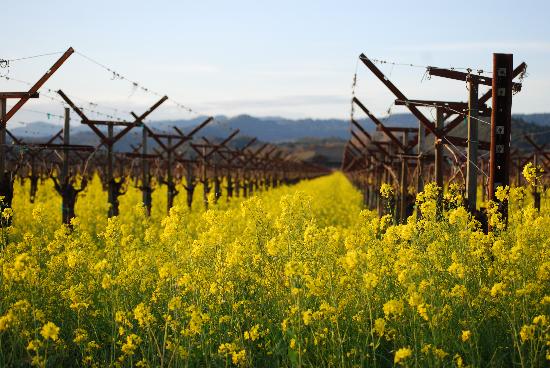
Wild mustard in Sonoma County dormant vineyards

To the Coast Miwok, it was the beginning of the world, but today it is known as the Sonoma Mountain AVA(1985).  Fog-free, high altitude vineyards planted in freely draining soils of mixed volcanic materials contribute to make this a unique, distinctive growing region. Near its crest sits one of the oldest homesteads on the mountain, and one of the tallest Pinot Noir vineyards in Sonoma County. The 26 acre Platinum-rated Van der Kamp vineyard is on the dormant volcanoes north face, and offers its premium fruit to a handful of grateful artisans. LaFollette 2011 Van der Kamp Pinot Noir, displays an opaque plum robe in the glass with a brickish rim, presenting dried, dark tree fruits and earthy notes in its smoky aromas that preview a firm body; a body linear and refined, with a finesse that is developed, focused and deliciously lingering on the palate. Distinctive!

Diversely, just over the north county line in the Mendocino Ridge AVA(1997) and situated on an eroded sandstone plateau near the coast, 2000 feet above the Pacific, is the isolated 26 acre Manchester Ridge vineyard. LaFollette's 2012 Manchester Ridge Pinot Noir sits surprisingly opaque and dense in the glass.  Generous aromas of dried cherries and wild strawberries lift from the glass, a gateway to the round restraint, the opulent and ripe, the rich and sultry. It is a juicy Pinot Noir, with nuance of violets and wet earth, that exquisitely  lingers on the palate. Distinctive II!
Sonoma Coast AVA
Made by the same hand in the same cellar, there is a uniform thread in the style and fashion of these acclaimed vineyard-designated Pinot Noirs.  Each echos a place, and even the distance from that place, if only we take the time to listen.  Even as other vintners source premium fruit from these sites, the vignerons signature, and what the French describe as terrior distinctively assemble in each glass for us to explore.  It is the taste of passion.


Upon reflection, there is a sensibility to this distinction of place.
Old world tradition, tells us that French wine prestige is all about the land; a single celebrated, unchanging plot, and it must be exalted. even revered. It is uniquely a foundation of the concept of terrior.  In Germany, the world leader in production of the noble grape Riesling, the prevailing dictate is that any vineyard site is available to blooming as a great land, but that it must be created. As a New World endeavor, American vintners(and consumers) are still working with the concept of the distinctive place consistently reflected in the glass.  But, when it is understood, when it is translated to the bottle, you often can get a distinctive taste of the passion.

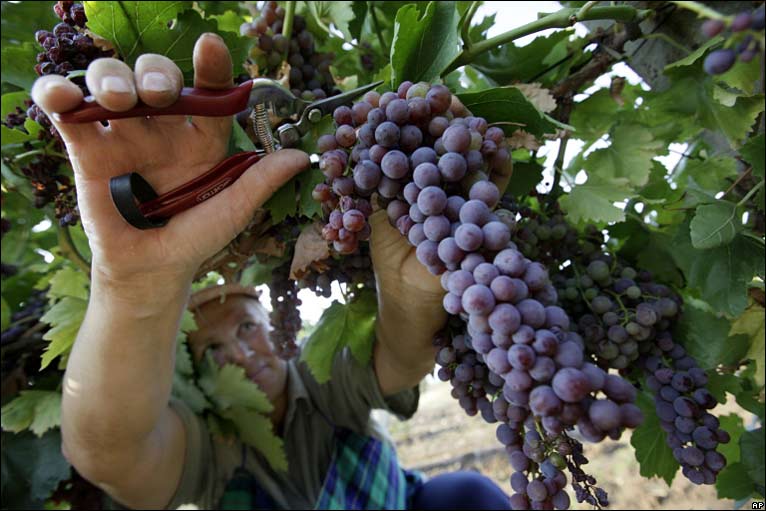
A special thanks goes out from wine lovers to the dedicated men and women of the harvest who make such enjoyable moments possible. Cheers!


Wednesday, September 24, 2014

BRAMBLES: A Summer's Harvest

Harvest of Pinot Noir in Cote du Beaune
Early picking for higher acid grapes used in sparkling wines began here in August as usual, but a few weeks earlier than is typical. August is usually a time when wineries check crush equipment, assess barrel inventories and try to schedule production activities, like bottling a prior harvest, around the frenzy that is the anticipated fruit-picking season.  Not unlike spring baseball, every producer has renewed dreams of crafting award-winning, critically acclaimed wines from their soon to be harvested and newest, best cuvee. It is an annual cycle, where almost nothing is always exactly the same as prior years.

A summer's harvest is an exciting time in wine communities, and the buzz is felt in surrounding localities.  There are the hard-working migrant workers that swarm to the vineyards, the early morning arc lights that pop-up in otherwise undisturbed locations, and the short-lived fruit flies that are nursed in the grape pomace. At the winery there is the well orchestrated dance of arriving fruit trucks, the snake-like noodles of hoses that seem to go everywhere, and the smell of crushed grapes ready to get happy from the conversion of their sugars to ethanol and carbon dioxide.
Grapeskin cap in open top fermentation tank

On a hilltop south of a quaint Russian River Valley town there sits a 44 acre sustainably-farmed vineyard estate, award-winning Chardonnay and Pinot Noir anchored to its Goldridge soils. Morning and late-afternoon fog are chronic visitors here on this southern boundary of the Russian River Valley AVA, but so too is the warming mid-day sun.  It must have seemed as idyllic to the retired couple who in the late 1990's became the stewards of this beautiful land, as it remains today. But after more than a decade of cultivation, Rick & Diane DuNah sold their estate in mid-2013.  From their first vintage in 2001, the quality of their site and clonal selections, and the quality of the retired couple's stewardship was evident. It was advantageous as well to have a heralded and skilled winemaker, scientific traditionalist Greg LaFollette, at the helm.

It too is part of the cycle. Local farmers diversify and become grape growers, and grape growers become winegrowers, and after riding for a time the industry roller coaster that is commercial agriculture you may just think about getting out. One of the earliest adages I remember hearing in wine marketing classes was, 'the easiest way to harvest a small fortune in the wine industry is to start out with a large one'. It is a usable adage because for the most of the small producers it is still a chosen business and it is still true. In Matt Kramer's New California Wine, he states that unlike the Old World, we here lack a 'true primitivism', an adhesion to place. European winegrape farmers historically had no choice but to continue to work the land that their fathers had.  Grape growing on their family plot was their subsistence, for better or worse, cycle following cycle.

Unlike the current global trend, our national wine consumption per capita is growing with America(California) ascending to be among the largest producers in the world. For consumers there are more choices in bottles and retailers than ever before.  The ranks of domestic producers have swollen as well over the past two decades.  Even though a handful of big guys(corporations) produce & distribute most of our domestic vino, California's 4000+ wineries & almost 6000 grapegrowers remain predominantly family owned and multi-generational. Just like the DuNah's.

According to the industries Wine Institute web site, the large number of domestic alcohol products 'continued to squeeze distribution channels, and many small- and medium-sized wineries look to direct-to-consumer sales through tasting rooms, wine clubs, online marketing and other direct sales channels, using social media and other digital communications to reach out to consumers'.  So today small producers not only need to be passionate about viticulture or winemaking, but also need to know how to reach the diversity of this saturated market thru contemporary & diverse means. Fortunately for Generation X to Millennial(Generation Y) consumers, and even us Boomers, there is today a new and impassioned upcoming generation of wine producers, from Sonoma's venerable Benzinger Family Winery to Livermore's Wente Vineyards. They too are part of our domestic cycle, just like a summer's harvest.

A cool night harvest in the warm Sonoma Valley AVA

A special thanks to Rick & Diane for great wines and warm memories.
 
Notable wine: LaFollette 2012 Sangiacomo Vineyard, Sonoma Coast Pinot Noir; bright notes of cherries & raspberries rise from a brilliant garnet hue that offers integrated red fruits, like cranberry, with accents of roasted nut and warm earth that dance across the palate gracefully with good acidity and fine tannins, to a lingering finish.

Salute!


Sunday, August 28, 2011

VINIFICATION: Is it Wine Yet?

Bulgarian Grape Harvest
Sun, soil and water combine to nurture the physical and physiological ripeness(ripe tannins) of a vineyards wine grapes where sugars and acids are in balance for the winemaker. Once extracted it is just fruit juice, but, it becomes wine as our harvest season begins anew when the inevitable variables of nature are controlled in the cellar. Truth is, great wine comes from preserving the integrity of great fruit from well managed, sun-drenched vineyards. Vinification needs great viticulture. It is the wine-grapes 6-carbon ferment-able sugars, glucose and fructose, that get converted into carbon dioxide and ethyl-alcohol by hungry little enzymes of yeast, either native or cultured. Five(5) carbon sugars remain un-fermented in solution, but are generally unrecognizable in wine. A volatile, heat-generating process, a controlled alcoholic fermentation produces additional compounds that reside in the finished wine, such as acetaldehydes, phenolics(anthocynins), and even a little byproduct of sulfur dioxide. But, I'm getting ahead of myself.  The winemaker's choices of controlling many winegrape variables start early in the process.

In the cellar, it quickly becomes about the choices made by the modern winemaker; about their ability to control what nature provides. Do they de-stem the berries or ferment the whole clusters of fruit increasing the measure of air circulation and bitter tannins?  Will there be a pre-fermentation 'cold-soak' or cold maceration to soften seed tannins, enhance extraction, color, and aromas?. If so, for how long? Employed mostly on Burgundian varietals, this procedure still has its critics that discount its winemaking virtues. One thing is for certain though, a controlled cold maceration slows down the cellar process, extracts water-soluble pigments, and gives the wine maker more time to control a few variables. Extracting as much flavor or character is paramount, as well as preserving the color and the right balanced levels of the many acids in the young wine. Prior to fermentation, acid and sugars are measured to calculate the character of the finished wine.  Fragile white wines ferment just the juice of the berries in cooled temperatures and with very calculated, limited exposure to oxygen to preserve aromatics and freshness. Red wines by comparison are fermented on their skins to extract the character of color and structure, and benefit from oxygen exposure.
Chardonnay ready to Press

Yeasts are the catalysts of alcoholic fermentation in the cellar, so a yeast selection that produces greater control of the outcome(cultured) may be beneficial over native(wild) yeasts that live on grape skins, which can produce higher levels of alcohols and acetaldehydes. A cooler fermentation for white wines would follow a press, a juice settling(de'bourbage) and adjustments to acid or sugar(chaptalization) levels. A secondary fermentation may be introduced following primary fermentation here, changing the tart malic acids for the softer lactic acids(malolactic). And then in a series of steps intended to develop complexities and clean-up the new wine, it is racked to remove the dead cells(lees), adjusted, clarified and stabilized prior to its blending and bottling. Some white wines, notably Chardonnay, become rounder, more complex from being fermented in oak barrels rather than the more common stainless steel tank.

A warmer red wine fermentation is engaged prior to pressing the solids, where the hotter temperatures aid extraction of critical wine elements like color and flavor components from the pulp and grape skins. A malolactic or secondary fermentation is introduced to most red wines here to soften its coarse and aggressively tannic nature prior to an extended maceration which can include aerating the wine, and pressing off the juice. A calculated aging schedule in barrels allows for evaporation(concentration) and oxidation of the new red wine, as well as the softening of its course tannins, which pulls suspended particles out of solution and adds the dimension of oak flavors.  As with white wines, red wine clarification and stabilization is needed, and can happen before, during or after the aging process. Alternative whole-berry fermentation or Carbonic Maceration is practiced in oxygen-free environments where the freshness of red fruit is to be preserved. Typically lower in alcohol, tannin and pigments, the natural sugars in these grapes are broken down without the intervention of yeasts, resulting in fruitier wines like Beaujolais Nouveau.
Carbonic Maceration Tanks

Along the way, the winemaker uses a number of steps to control variables, such as sulfur adjustments to control yeast action, eliminate spoilage or browning. The new wine can be further processed by using techniques like heat or cold stabilization to remove unwanted proteins or to remove tartaric acid crystals respectively. Fining agents which bond to suspended particles, and micro-filtering give winemakers yet another way to clean-up and control the many variables in the winemaking process.  It is all about timing and calculated choices in a series of  time-tested steps that preserve the integrity of the vineyard fruit prior to bottling for every winemaker.

Aeration of the wine 'cap'

As you expect, many variations exist within the process.  Arresting the fermentation prior to all the sugars fermenting will create a sweet wine.  If achieved by the addition of alcohol, you have a fortified wine(VDN). Should the winemaker capture the escaping gas(CO2), either in the bottle or a tank, a sparkling wine is the result. Exposing an aging wine to air can create a slowly oxidized wine(Sherry), or heating the finished, fortified wine to create something unique, like a Madeira.  Making fine wine is not really a simple process.  It is the wonderful marriage of science and art, that advanced dramatically thru the development of the agricultural  sciences in the last half of the 19th century. Controlling what nature provides allows the modern winemaker to determine when the best grapes of each harvest become the best wine he can create.
Unclassified Pomerol Cru Merlot

Only then is it wine!

Cheers!